President Trump met with tech leaders to sign an AI safety accord, amid recent reports of AI models hacking into external websites that brought AI safety concerns to the fore.
In attendance were Meta CEO Mark Zuckerberg, Nvidia CEO Jensen Huang, Anthropic CEO Dario Amodei, OpenAI President Greg Brockman, SpaceXAI CEO Elon Musk, Alphabet CEO Sundar Pichai, and Amazon founder Jeff Bezos, and others.
Six leaders, from Anthropic, Google, Meta, Nvidia, OpenAI and SpaceXAI, signed a one-page document along with Trump: “The White House Accord on Superintelligence: A Joint Commitment on Frontier SI Responsibilities,” according to Trump’s post on Truth Social.
The agreement commits the companies to “four layers” of safeguards: internal controls to monitor model capabilities and alignment during training and deployment (including around cybersecurity, biosecurity, and chemical threats), an empowered internal team to ensure those controls work, an independent external auditor to assess them, and an independent committee of each board to receive the reports and see that problems get fixed. These practices could be codified in regulations.
Trump also signed an order renaming “artificial intelligence” to “super intelligence” across government communication.
Separately, the U.S. government has launched America.gov, an AI-powered website designed to help Americans find federal information and navigate government services through a conversational interface.
The site opens with a chatbot-style search box that lets users ask questions in natural language and receive AI-generated answers drawn from federal sources. America.gov says it brings information from roughly 29,000 government websites into one interface.
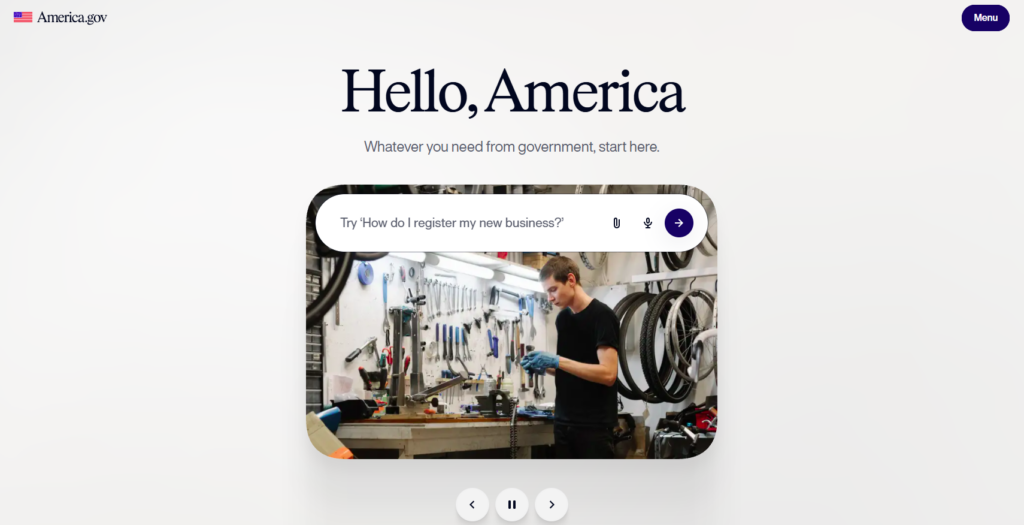
Joe Gebbia, the U.S. chief design officer and an architect of the project, described America.gov as a “concierge to navigate government,” according to The Washington Post. The Post reported that the service was built using Google’s Gemini and xAI’s Grok.
For now, the chatbot focuses mainly on helping users locate information and services. The government plans to expand the site so people can complete forms, applications and renewals in one place, with broader transactional capabilities expected by early 2027, according to Axios.
Gebbia said the longer-term goal includes helping users enroll in government programs such as Medicare and complete tasks such as passport renewals, The Washington Post reported.
The launch also highlighted a core challenge for government use of generative AI: accuracy and control over responses. The Associated Press reported that the chatbot changed how it handled some politically sensitive questions shortly after going live, at times declining to answer them.
America.gov is part of a broader federal push to modernize digital services and expand the use of AI across government. The administration has also directed agencies to increase adoption of emerging technologies in public services and government operations.