
There’s a pattern worth paying attention to in how technical roles have evolved over the last few years.
Sales teams got GTM engineers, people who build automated prospecting and enrichment systems instead of manually working lists. AI companies rolled out forward deployed engineers, who sit with customers and build working systems on the spot instead of handing off requirements. In both cases, a role that once ran on manual effort and headcount now empowers someone to operate a system.
Marketing is next, and honestly it’s a better fit than either of those.
While a GTM engineer can build a beautiful outbound system, changing how a sales team actually sells is slow because it runs through people, training, comp plans, and quarters of behavior change. Demand gen doesn’t have that constraint. Ads, posts, landing pages, and campaigns can be changed today and measured tomorrow. The feedback loops are short, the surface is digital, and nothing has to route through a human’s habits to take effect.
If any domain was built for an engineering approach (rapid experiments, high volume, tight measurement), it’s this one. The irony is that demand gen has been run more like a craft shop than a lab, with a handful of campaigns a quarter, an agency on retainer, and a retro at the end that says “some of this seemed to work.”
That wasn’t anyone’s failure. Truly understanding what converts (specifically the hook, format, voice, audience, and channel) and acting on it continuously was more work than any team could staff. So when marketers needed more output, they had exactly two options: hire more people or hire more agencies. Both can be slow and expensive, and neither actually compounds. You buy output, not learning.
AI changes the math, but not in the way most of the “AI for marketing” pitches suggest.
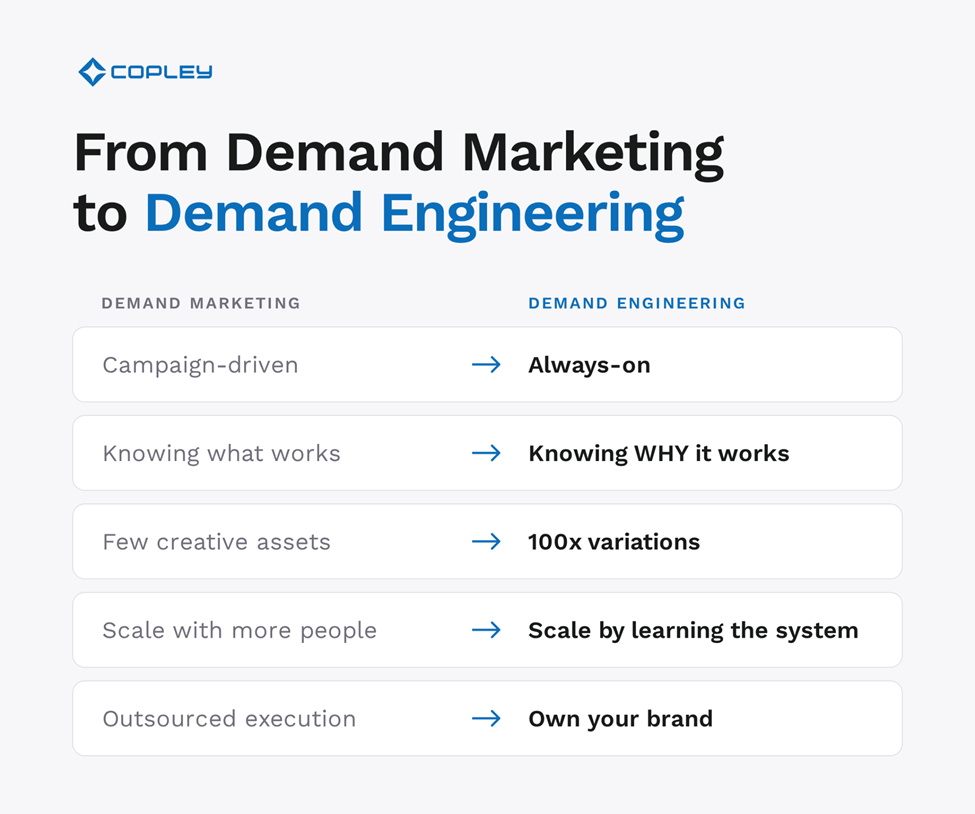
The opportunity isn’t cheaper content. It’s that a marketer can now personally operate a system that would have required a department, deploying agents that generate variations, run experiments, watch performance, flag anomalies, and refresh creative across channels, all inside a harness where the marketer sees and controls everything. That’s the role shift. A demand marketer produces campaigns, while a demand engineer runs the system that produces them.
What the job looks like in practice:
You know what’s working, specifically. Not “engagement was up.” You know the traits of what converts for your ICP (the hooks, formats, lengths, and voices that perform) because the system measures at that level. Your instincts get sharper every week because they’re fed by evidence instead of anecdotes.
You run at 100x the volume, deliberately. Not 10x, but 100x. A demand marketer ships a campaign with three assets. A demand engineer ships dozens of variations through a phased approach, reads the results, and ships dozens more informed by what just happened. That was reckless when every asset cost real money to produce. Now it’s just how you learn faster than everyone else. More iterations mean more signal and more signal means better next iterations.
You work in one place, across every channel. LinkedIn, Google, Meta, organic, and the AI assistants where buyers increasingly ask their questions – this is one view, one system, one set of results. Refreshing a long-running ABM program, tailoring a launch across channels, keeping evergreen spend from going stale: This is daily operation of one system, not a quarterly scramble across five silos.
You stay in command of the brand. This is the part that separates a demand engineer from someone who just turned on the autopilot. The agents generate and monitor; you set the direction, define the voice, curate what ships, and decide how much to delegate as the system earns your trust. Ultimately, your judgment finally has leverage and is applied to a hundred things at once instead of hand-applied to three.
The tooling question follows from the role. You wouldn’t ask a GTM engineer to work without their stack, and you can’t do this job with a content calendar, a spreadsheet, and six channel dashboards.
Demand engineering needs a purpose-built harness where you see everything that’s running, understand what’s working and why, generate and test at volume, and control the agents doing the work. In the past the answer to “we need more” was always more staffing and more agency. The answer now is a better harness and a marketer who knows how to run it.
The leaders who make this shift are going to be very hard to compete with because their taste is compounding, backed by evidence, and applied at a volume nobody can match by hand.
Author

Get the latest insights about enterprise AI.
Subscribe to our newsletter. Thank you.




Be First to Comment