TLDR
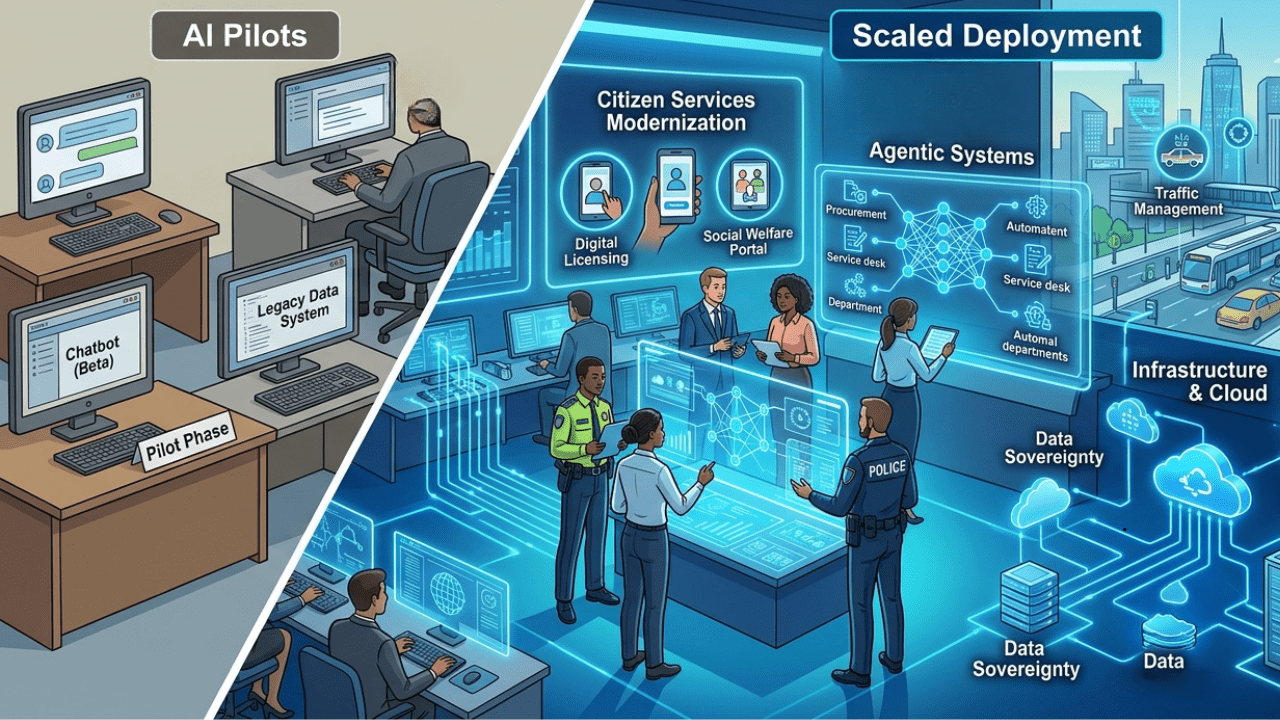
- Governments are interested in AI but moving cautiously, with pilots still dominating over full-scale deployments.
- HCLTech is focusing on scaling AI in the public sector, particularly in citizen services, infrastructure modernization and cybersecurity.
- Long procurement cycles and strict compliance requirements remain the biggest barriers to adoption.
HCLTech is expanding its push into government AI to help agencies move from pilots to scaled deployments as demand grows for modernization, better citizen services and cyber resilience.
“We’ve been serving the public sector for the last two decades,” said Arjun Sethi, chief growth officer and global head, public sector, aerospace and defense and PE practice at HCLTech, in an interview with The AI Innovator. He pointed to work across U.S. states as well as international engagements in transportation and law enforcement.
Now, the focus of the technology services giant is on further expansion. “We’ve been in the arena. Now we need to scale it,” he said, outlining plans to deepen presence in key U.S. states and expand existing relationships.
The strategy comes as governments show growing interest in AI but remain deliberate in how they adopt it. “The public sector is very active and energized to both learn and hear about AI as well as to deploy,” Sethi said.
At the same time, adoption is not yet widespread. “The uptick is not yet fully there, but the number of conversations give me confidence that this will be something that will be taken up aggressively in the months and years to come,” Sethi said.
That gap between interest and deployment is where HCLTech is focusing its AI offerings, combining its engineering capabilities and platforms with large language models and agent-based systems.
The company’s internal platform for building and deploying AI systems, AI Force, underpins much of that effort. HCLTech also works closely with OpenAI as part of its model strategy. “We are one of the top three providers … who works very extensively with OpenAI, and we go to market as well with OpenAI,” he said, calling it the company’s “dominant partnership.”
The broader approach reflects a shift in enterprise AI from standalone models to integrated systems that combine models, data and workflows. HCLTech’s offerings include advisory services, agent-based automation and governance frameworks designed to help organizations transition “pilot concepts into production-ready agentic systems,” according to the company.
Government use cases
HCLTech’s work in government centers on modernization of legacy infrastructure and improving citizen services.
In one U.S. deployment at a “fairly large county,” Sethi said, “we are helping take what is a very legacy infrastructure to the cloud.” Other projects focus on social services. In the U.K., HCLTech supports law enforcement agencies. “We are very well known, and a highly regarded provider,” Sethi said.
The company also works with educational institutions through a dedicated vertical and a partnership with educational publishing and services giant Pearson. “We are working with quite a few educational institutions and universities and academia leveraging the Pearson platform,” he said.
Across sectors, the goal is to reduce friction in how users interact with government systems. “There is a lot of friction in the interaction between constituents,” Sethi said. “Whether it is applying for a new license, whether it is getting on a child welfare platform and taking the next payment slip, that engagement model is full of friction.”
He said improving that experience is the primary AI opportunity. “The topmost thing that I see from an AI perspective is enhancing the day-to-day experiences of constituents,” he said.
AI-driven modernization and agents
Beyond citizen-facing services, agencies are increasingly turning to AI to modernize aging infrastructure.
“There is a lot of legacy infrastructure that is sitting across the public sector arena − old machines, old infrastructure, old code, which actually creates a security issue as well,” Sethi said.
AI, particularly agent-based systems, can accelerate modernization. “You can now use AI agents to upgrade everything from your servers to your CPUs,” as well as providing “service desk support to Software Asset Management or SAM,” he added.
Data centers are one area where that shift is already visible. “Modernizing of just the data center piece, and then ongoing servicing and maintenance of data centers, can all be aided by agentic AI solutions,” he said.
In parallel, it is expanding AI-driven customer service capabilities using Microsoft Nuance technology to improve help desk operations.
Beyond back-end systems, HCLTech is also deploying AI in physical environments. The company has introduced VisionX, a physical AI system used in ports. “We’ve deployed VisionX … to help with worker safety as well as port congestion management,” Sethi said.
Procurement and structural hurdles
Despite growing interest, public sector adoption remains constrained by structural factors, particularly procurement cycles.
“The cycle could be anywhere between 12 and 18 months,” Sethi said, calling it “probably the single biggest hurdle.”
Government engagements also require stricter compliance and operational discipline than private sector projects. “You have to be very disciplined and rigorous in the response itself. It has to meet certain criteria. It has to meet certain guidelines,” he said.
Additional requirements include data sovereignty, onshore infrastructure and security clearances.
“Oftentimes, you need the ability to serve public sector requirements for data center that has sovereign on soil, and it requires ITAR presence,” Sethi said. ITAR stands for International Traffic in Arms Regulations, a rulebook for handling sensitive U.S. government and military technology.
These constraints also shape how AI is deployed, particularly in sensitive sectors such as defense.
Caution, governance and regulation
Public sector clients are approaching AI with caution, but not resistance.
“There is genuine interest, and there is a desire to learn with the intent to understand both the pros and the cons,” Sethi said.
That approach often results in slower adoption timelines compared with commercial enterprises. “They would like to demonstrate or see the success, even if it is through a small pilot first before implementing at scale,” he said.
Governance is a central focus. HCLTech has “very strong governance that we have instituted on everything that is AI,” Sethi said.
He described the technology landscape as rapidly evolving. “It’s a highly dynamic space. Every day, there is something new that you have to learn and guard against,” he said.
To manage global regulatory complexity, HCLTech takes what Sethi described as a localized approach. “The best word that defines how we think about the solutions we render is ‘glocal,’ a global organization that provides, in many cases, highly localized services and solutions,” he said.
What comes next
HCLTech’s next phase in government will focus on scaling deployments and integrating its software and services into more comprehensive solutions.
“Our ability to grow into the states that we have identified as high opportunity areas − establish our brand, our presence, earn the trust of our client team − is really what we need to do. It’s the next step,” Sethi said.
The company also plans to bring its international experience into the U.S. market. “We’d like to bring some of our global experiences … into the U.S. and leverage our global capability set,” he said.
Ultimately, the goal is to deliver integrated, end-to-end solutions. “Our ability to really harness what we are doing in the software space and the services space into a true solutions provision,” he said, “would be very nice.”
For now, the company is betting that steady demand and sustained engagement will translate into growth as government AI adoption matures.
“We need to be a little bit patient on that,” Sethi said. “But as long as we are patient and we have the staying power, our business will grow.”
Author

Get the latest insights about enterprise AI.
Subscribe to our newsletter. Thank you.