
TLDR
- AI success depends more on redesigning human-AI workflows than deploying new technology, with human-centered companies seeing better ROI, according to Deloitte’s Chief Futurist David Mallon.
- Companies that use AI mainly to cut costs risk losing the expertise, creativity and innovation that drive long-term competitiveness.
- Leaders should focus on learning, adaptability and trust, helping employees work effectively with AI rather than simply training them on new tools.
As companies scramble to weave artificial intelligence into nearly every corporate function, executives may be surprised to learn that the most crucial part of the transition is not the technology itself.
The key is optimizing the human and technology partnership to create a whole greater than the proverbial sum of its parts, according to David Mallon, chief futurist and head of research for Deloitte’s U.S. Human Capital practice. That means rethinking the view of AI as mainly a cost-cutter and efficiency enhancer.
“This really is a human challenge, not a technology one,” Mallon said in an interview with The AI Innovator. He argued that because companies increasingly have access to the same AI tools, the competitive advantage will have to come from the people using them. “Humans in the organization have always been the source of differentiation, and are going to even be more so going forward.”
According to Deloitte’s 2026 Global Human Capital Trends report, companies that take a technology-focused approach to AI are 1.6 times more likely to fall short of their ROI expectations from AI investments compared to firms that are human-centered.
For example, a European telecoms company added an ‘AI expert’ to its customer service department but kept its legacy systems and workflows. It only saw a 5% productivity increase. After it redesigned its human-AI interaction with new workflows, escalation paths, trust thresholds and training, productivity increased by 30%, according to the report.
The consulting firm defines tech-centric companies as those that layer AI onto legacy systems without redesigning workflows or jobs. A human-centric approach to AI takes a holistic approach that not only adds the technology but also changes the workflows, job responsibilities, strategies, interactions and the like to harness people’s creativity, judgment and adaptability.
Humans as sources of innovation
AI adoption has often emphasized automation and headcount reduction. Recent waves of layoffs across the technology sector have frequently been attributed, at least in part, to AI-driven productivity gains.
But Mallon cautions against simplistic assumptions. Organizations, he said, are under intense pressure to maximize efficiency, and AI appears attractive in that context as a replacement for human workers. But the danger, he argued, is that firms pursuing an “all agentic” future may erode the very capabilities that sustain long-term competitiveness.
“You might save some money,” Mallon said. “But in the long run, you suddenly don’t have the sources of innovation or expertise in whatever it is that you do, because no one’s learning that anymore.”
“It’s really easy to fall into the trap of thinking about AI as just another wave of technology,” he added. “This is not SaaS, this is not cloud. You’re not going to be able to implement the tech and then afterwards, catch the people up through training. You’re going to need to bring those people along from the start, and you’re going to need to design for the (human-AI) relationship.”
Such concerns echo a broader theme running through the Deloitte report: that AI is compressing the traditional corporate “S-curve” of growth, forcing companies to reinvent themselves more quickly and frequently. Historically, firms could spend years scaling a business model before confronting disruption. AI shortens those cycles dramatically. The result is an environment where long-term planning collides with constant adaptation.
Nuances of AI’s role in the workplace
Companies have to figure out what the human-AI relationship will look like, which could include the following:
- Employees doing work with AI
- Employees supervising AI
- AI supervising employees and other AI
- Employees using AI as a muse, mentor, researcher, coach
For example, MetLife created an AI coach for its customer service representatives, which resulted in greater empathy for callers under emotional duress. As a result, customer satisfaction rose by 13% and call times dropped. The insurer also used the AI to monitor representatives’ stress levels and urges them to take recovery breaks after difficult calls.
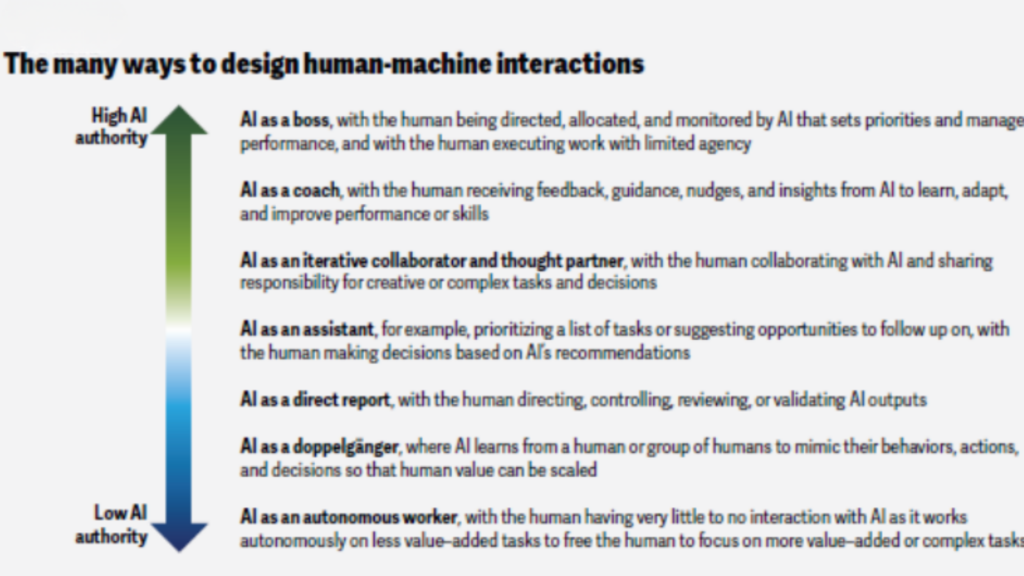
But the implications extend well beyond workflow optimization. AI is beginning to unsettle long-standing assumptions about collaboration, performance and even fairness inside organizations.
Among the unresolved questions: how to evaluate workers whose productivity is amplified by AI; how to distinguish augmentation from cheating; and how to redefine collaboration when employees increasingly rely on AI tools independently before reconvening as teams.
“Who do I reward?” Mallon asked. “The person who works 30 hours a week but has mastered the technologies or the person that puts in the 60-hour week?”
Incurring cultural debt
The report also warns that AI may be quietly accumulating what Deloitte terms “cultural debt” — the erosion of trust, cohesion and shared norms as companies neglect their cultures. According to Deloitte, 42% of workers said their organization “rarely” evaluates the impact of AI on people.
Culture is built on trust. AI is chipping away at that corporate trust, with 80% of managers, leaders and workers worried that their co-workers are using AI to appear more productive than they really are. Employees’ behaviors are changing. Is it cheating if an employee uses AI? Who is to blame if AI is wrong? What is hard work if AI is doing the heavy lifting?
“Most companies are just not thinking about this, and they’re going to catch themselves in traps because the workforce will fill the vacuum,” Mallon said. “People will begin to figure out their own ways (of working with AI); it may not necessarily be what the organization wants.”
Against that backdrop, Mallon argues that leaders should focus less on training workers to use particular tools and more on cultivating adaptability, curiosity and experimentation.
“This is a moment in which we need more learning, not training,” he said.
The distinction is important. Training implies standardization and procedural consistency. Learning implies exploration — and perhaps a willingness to tolerate ambiguity.
“We need to encourage, actually, a degree of play,” Mallon said. “So invest in these tools. Put them in the hands of your workforce. Give them educational opportunities that actually encourage them to expand their curiosities, to bring their imaginations to the table, to help you as a leadership team imagine what the new work’s going to be on the other side.”
That mindset, he believes, may also help alleviate mounting worker anxiety over AI-driven displacement. If companies make it obvious that employees will be involved in the reinvention of work, they will be much more engaged.
“The only antidote to fear is imagination and curiosity,” he said. “You have to engage the workforce in feeling safe enough to imagine their own futures.”
Author

Get the latest insights about enterprise AI.
Subscribe to our newsletter. Thank you.