TLDR
- Stack Overflow’s traffic and user engagement have collapsed in the ChatGPT era, forcing the company to reinvent itself around trusted, verified technical knowledge.
- The company is repositioning itself as a ‘verification layer’ for AI by combining AI-generated answers with community-vetted content and reliability scoring.
- Stack Overflow sees its biggest growth opportunity in enterprise AI, helping companies organize and surface internal knowledge scattered across tools like Slack, Jira and GitHub.
Stack Overflow, a popular online forum where developers posted questions to solve technical problems, was riding high. It was the early 2010s and the site was getting around 165 million monthly visits with users posting 6,600 questions a day.
In November 2022, ChatGPT exploded onto the scene. Developers who once turned to the online Q&A forum for answers now flocked to generative AI, according to ITPro. Stack Overflow traffic began to decline. As of February, traffic was down 73% to 45 million, according to Semrush. Last month, the number of questions posted per day fell 97% to 170.
Stack Overflow faces an existential crisis. Can it be saved?
Its Chief Product and Technology Officer Jody Bailey is optimistic. “We are pivoting, we are adapting,” he said in a recent interview with The AI Innovator. “What’s our role in that AI space? We really believe it is still hinged fundamentally on that knowledge that people can trust.”
For years, Stack Overflow functioned as a kind of collective brain for software developers. A question posted in public would be answered, debated and refined. The best answers rose through voting. The archive grew into one of the largest repositories of technical knowledge on the web.
Bailey said Stack Overflow, which is one of several forums owned by Stack Exchange, is reframing itself around something AI still struggles with: trust.
Trust is everything
Stack Overflow’s own data points to the gap. About 83% of developers use or plan to use AI tools, according to its 2025 developer survey. But nearly half say they do not trust what those tools produce. Moreover, 35% of developers go to Stack Overflow to resolve AI-related issues.
These tensions have become the company’s opening. “If you don’t have the appropriate security constraints and tests in place, and you put something bad out, you get to put it out 100 times faster than you did before,” he said, meaning errors can spread much faster.
Stack Overflow’s response is to reposition itself as a verification layer – a place where answers are checked, sourced and explained, even when they originate from AI tools.
On its public platform, the company has introduced an AI-assisted interface that lets users ask questions in natural language. The difference is that answers are tied back to existing posts and community-vetted content.
At the same time, the company is changing how the site feels to encourage more participation. It is adding chat features, activity feeds and coding challenges. The goal is to make the platform less static and more interactive.
Enterprise opportunity
But the bigger bet sits behind the firewall. Stack Overflow is moving aggressively into enterprise software, where it sees a problem AI cannot easily solve: internal knowledge.
Inside companies, critical information is scattered. Some of it lives in documents. Some of it sits in Slack threads. Some of it is institutional knowledge. Large language models don’t have access to all this data.
Stack Overflow’s answer is a product called Stack Internal. It acts as a private version of the platform, pulling in information from tools such as Slack, Jira and GitHub, organizing it into question-and-answer formats and scoring it for reliability, according to Bailey.
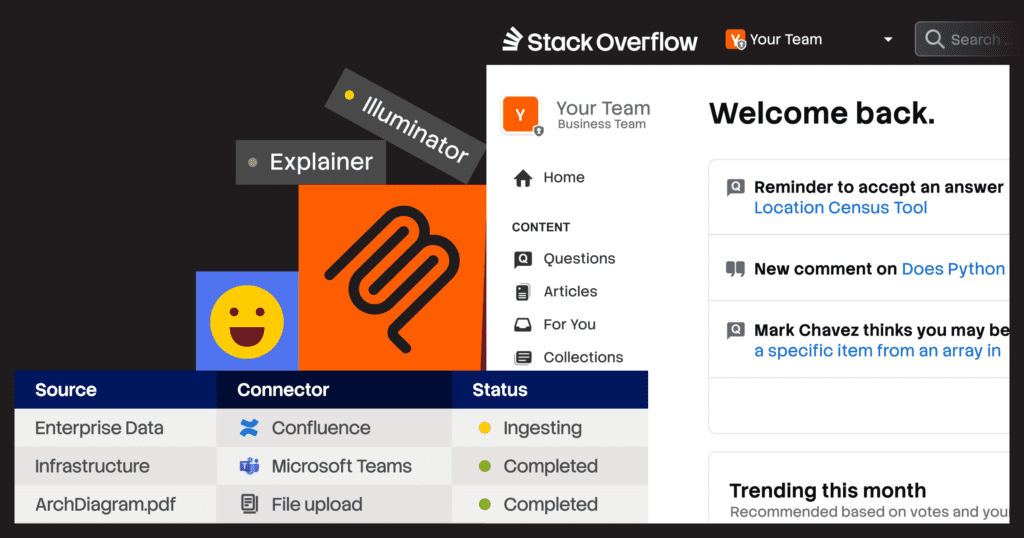
The system tries to solve a familiar problem in a new way: how to capture what a company knows and make it usable.
Bailey said the company is also working to embed that knowledge directly into developer workflows. Instead of requiring employees to search a site, the system surfaces answers inside coding tools or collaboration platforms. It can also capture new knowledge automatically as work happens.
The company is moving toward what it calls ‘Knowledge-as-a-Service.’ It licenses its data to AI companies and sells enterprise tools that organize and validate knowledge inside organizations.
In effect, Stack Overflow is becoming both a supplier to AI systems and a layer that sits on top of them.
To be sure, it faces plenty of competition. Platforms such as GitHub are integrating AI directly into development environments, combining code, collaboration and assistance in one place.
Bailey argues Stack Overflow’s advantage is breadth. It is not tied to a single tool or workflow.
“It doesn’t require somebody to actually be in one specific tool,” he said. “Not everybody is using GitHub, not everybody’s necessarily using Jira. The idea is to make this public and accessible to as many people as possible.”
Author

Get the latest insights about enterprise AI.
Subscribe to our newsletter. Thank you.