Federal Reserve policymakers are now paying far more attention to AI as massive spending on data centers and computing equipment raises questions about its effects on prices, financial markets and the broader economy, according to an analysis by The Washington Post.
AI has moved from the margins of Fed discussions to a major factor in debates over inflation, economic growth and financial stability.
Fed Chair Kevin Warsh highlighted that shift last week in his first major speech since his nomination by President Trump, saying the economy had reached a “hinge point in history” because of AI. Warsh said the technology could accelerate economic growth but raised questions about its effects on workers, productivity and living standards without offering firm conclusions, the Post reported.
The change at the Fed has been rapid. AI was not explicitly mentioned in published minutes of Federal Open Market Committee meetings in 2023 or early 2024. The technology first appeared by name in minutes from the Fed’s April-May 2024 meeting, when some officials suggested AI could eventually raise productivity.
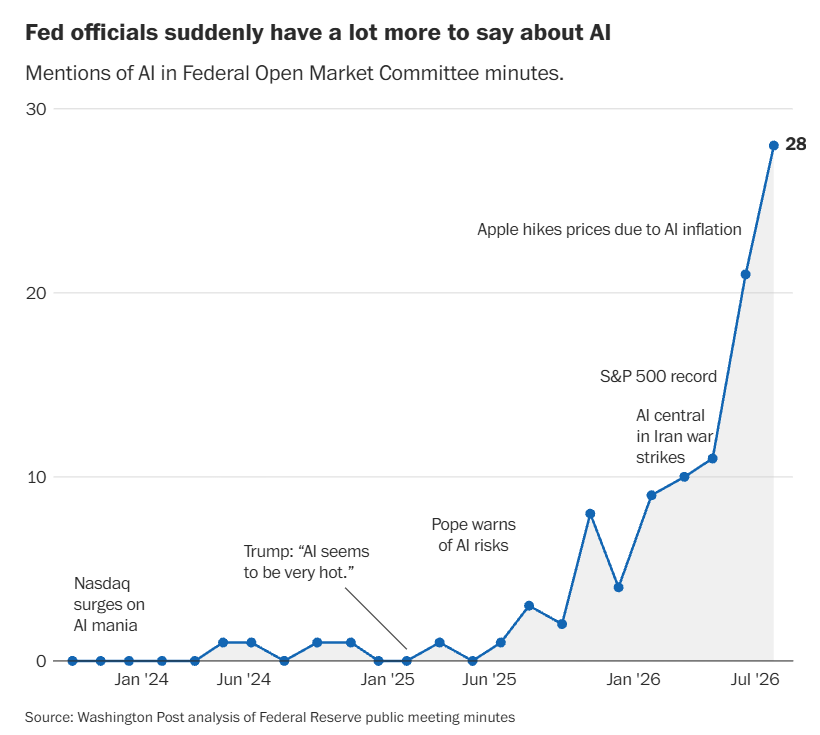
By mid-2025, the scale of AI investment was becoming harder for policymakers to ignore. Major technology companies began spending hundreds of billions of dollars annually on projects that included data centers packed with specialized chips, according to the Post. By December, some Fed officials were considering whether AI-driven productivity gains could allow the economy to grow faster without generating additional inflation – while potentially reducing job creation.
The near-term picture has become more complicated.
In January, Fed officials discussed risks including high valuations of AI-related stocks, the concentration of market value among a small number of companies and growing use of debt to finance AI infrastructure. Some officials also raised concerns about financing taking place in less-transparent private markets.
Inflation has emerged as another source of disagreement. Minutes from the Fed’s July meeting showed some policymakers thought AI infrastructure investment had affected prices only in selected areas. Others believed the spending was already pushing prices higher more broadly by increasing demand.
The Post cited higher prices for consumer electronics including Amazon Kindle e-readers, Nintendo Switch systems and Mac computers as examples of inflation associated with the AI investment boom.
Michael Strain, an economist at the American Enterprise Institute, told the Post that AI has not yet delivered the broad productivity gains some advocates expect, while the enormous investment required to build AI infrastructure is adding to inflation.
The debate leaves the Fed confronting two competing possibilities: AI could eventually help companies produce more efficiently, supporting economic growth without fueling inflation. But the infrastructure boom needed to get there could add to inflation and create financial risks.