Microsoft has unveiled Project Solara, a new platform that lets users speak to an AI-enabled device and agents will do tasks for them, no need to manually open apps and click through menus.
For example, instead of opening Outlook, Teams and a calendar app to prepare for a meeting, users could simply ask an AI agent to prep them for the meeting. The agent would gather information, summarize recent emails and identify action items.
“For the first time in our history, we can program, direct, and initiate action with computers the way we talk with each other. This higher mode of interaction enables the computer and us to be less dependent on the traditional way we have interacted with computers via keyboards, screens, or even premediated apps,” said Steven Bathiche, who heads Microsoft’s Applied Sciences Group, in a blog post.
For fans of Star Trek, Project Solara may evoke the main computer on the U.S.S. Enterprise. “Computer, summarize all Romulan activity in this sector,” a crew member might ask. No officer opens apps. The computer does all the work and provides an answer.
Bathiche also noted that historically, when a new user interface arrives, new devices also emerge. For example, when touchscreens became the user interface for smartphones, it led to other devices that used touchscreens such as smart watches. In an agentic web, speaking to a computer to do tasks is the new user interface, according to the company.
Microsoft revealed two prototype devices to show how Solara would work. One is a wearable badge with a screen, microphone and camera that could help nurses, retail workers and office employees access information or record notes while on the move. The other is a small desktop companion that can display reminders, answer questions and provide quick access to Microsoft 365 Copilot.
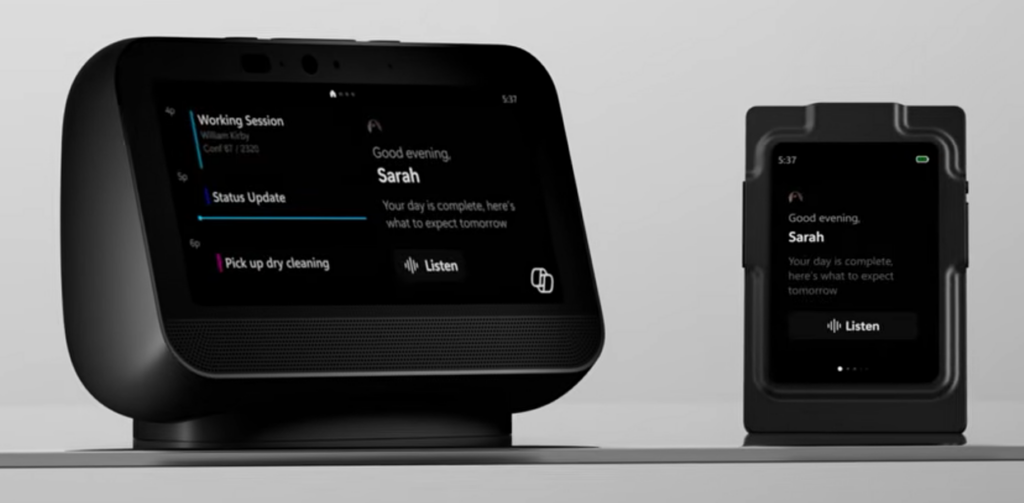
Project Solara’s tech stack comprises Qualcomm and MediaTek chips to power the devices, the Microsoft Device Ecosystem Platform, an Android-based operating system, biometric authentication, an agent shell that loads and manages multiple AI agents (think of it as Windows for agents), an agent platform and orchestration layer to coordinate tasks, cloud services and enterprise data, adaptive user interfaces and specialized device hardware such as badges and desktop companions.
Microsoft believes AI agents could eventually become as important to computing as apps and web browsers are today. Still, the vision remains largely experimental. Many of the capabilities Microsoft describes can already be performed on smartphones and PCs, raising questions about whether businesses will see enough value to adopt entirely new categories of AI hardware.