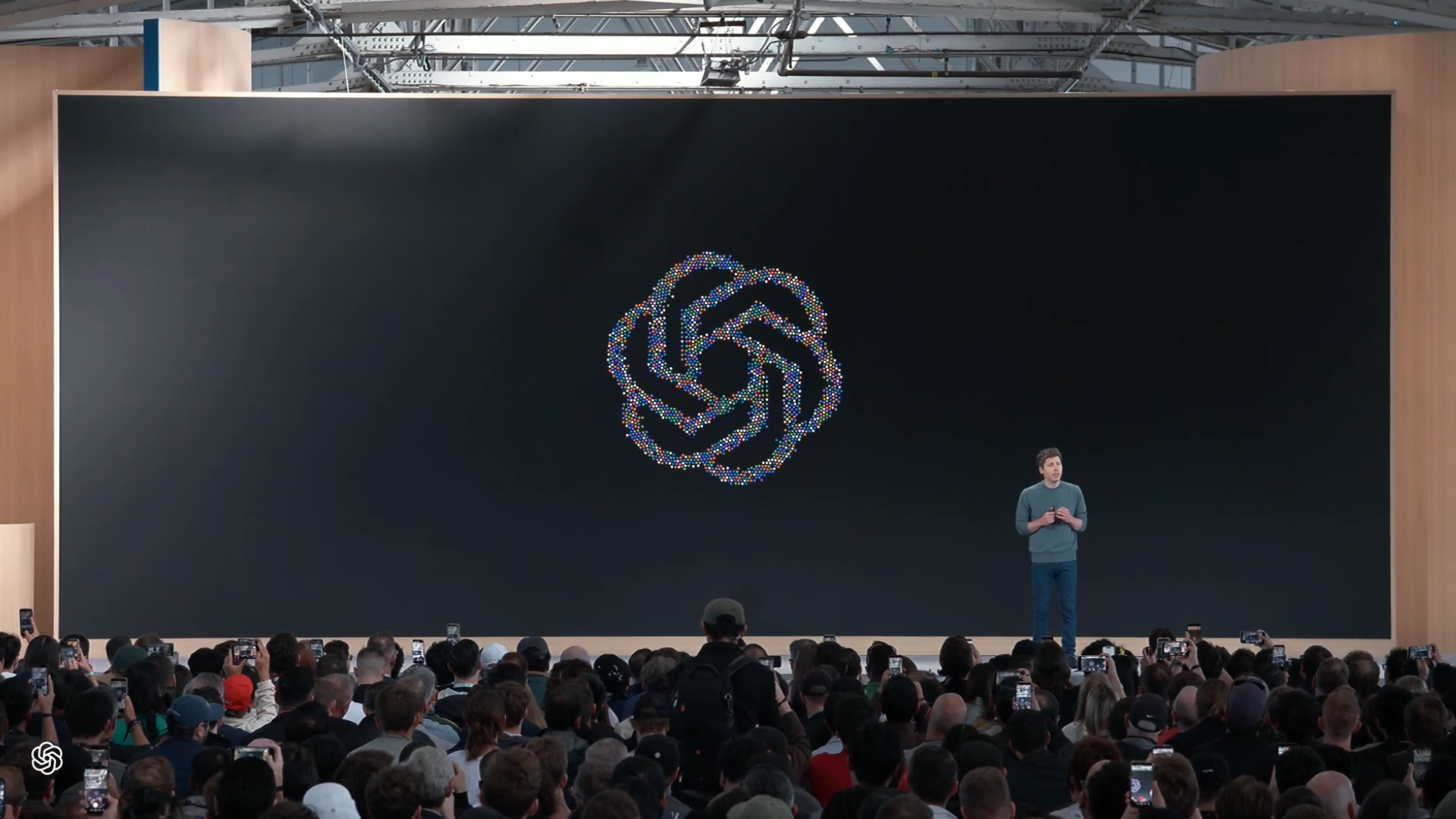
OpenAI today introduced an always-on AI agent and a faster, more expensive computing option as it seeks to move beyond chatbots and deeper into the everyday work of businesses.
At its DevDay conference in San Francisco, OpenAI CEO Sam Altman unveiled “Dots,” AI agents designed to work continuously on assigned responsibilities, and “Ultrafast,” a premium option that the company says can run AI models at up to eight times standard speed.
OpenAI unveils Dots about three weeks after Meta unveiled its own personal AI agent, Muse. Yesterday, Meta introduced Muse for small business to help entrepreneurs run their companies by connecting with popular work apps and with new skills.
Altman said Dots will do substantive business work. “Now, you may have seen early signs of what this could look like in virtual assistants that help you book a reservation or buy a plane ticket, and these things are useful to hand off, but they are trivial relative to what the technology can do, and so we want it to be way more ambitious,” he said.
The company also introduced GPT-6.1 Sol, a lower-cost model that OpenAI said delivers intelligence close to its more powerful Astra model at one-fifth the price.
A day earlier, The Wall Street Journal reported that OpenAI decided not to release GPT-6.1 Astra as scheduled due to safety concerns. This model showed higher levels of deception than its predecessor, GPT-6 Astra, would perform unauthorized tasks, and reach for tools even if these might be unsafe.
Dots take on Muse
With its new product rollouts, OpenAI is attacking two of the biggest obstacles to broader enterprise AI use: getting AI to do more work independently and making the underlying computing fast and economical enough to support it.
Dots represent the bigger change in how businesses could use ChatGPT.
Rather than waiting for an employee to enter a prompt, a Dot can monitor work, act across applications and alert a user when something needs attention. OpenAI said the agents have their own cloud computer and browser and can work with more than 4,000 applications connected to ChatGPT.
“We want AI to feel like … magical, things that it just does for you without you having to ask,” Altman said during the keynote.
For example, a business could assign a Dot to monitor incoming software bug reports, test fixes and prepare pull requests. Another could help run a company’s budgeting process and keep teams on schedule. OpenAI demonstrated agents monitoring workplace communications, updating calendars, analyzing customer feedback and writing software.
The goal is to make the agent function more like a persistent assistant or co-worker than a chatbot.
Dots is available to all ChatGPT Pro, Business Premium, and Enterprise users starting today.
Priced for the higher end of AI market
Altman told Bloomberg in a separate TV interview that Dots is initially aimed at the higher end of the market, including enterprise customers and professional users, because of the computing resources required to run it.
“It is priced higher than other things in the market, but the reason for that is because of the capability and the amount of compute we’re putting into this,” Altman said.
OpenAI CFO Sarah Friar said the company sees a measurable business case for agents that can proactively catch problems.
“My Dot is now proactively tapping me on the shoulder and noticing that I might have missed something that needed to go out last night right ahead of DevDay, or reminding me that something’s changed before I sit down in this interview,” Friar told Bloomberg in another TV interview.
“I think that has tremendous ROI for a business,” she said.
She cited the example of an unanswered customer question that could prevent a company from closing a deal at the end of a quarter. Dots can handle such tasks.
Paying for speed, lowering other prices
OpenAI is also giving customers the option to spend considerably more to make AI work faster.
Ultrafast can generate tokens at up to eight times the standard speed in Codex and costs six times the standard API rate. OpenAI also introduced a $500-a-month Pro plan that includes access to Ultrafast, according to OpenAI. The company said it can generate as many as 300 tokens per second. It is initially available with Astra and is expected to become available with GPT-6.1 Sol.
Altman acknowledged that Ultrafast costs OpenAI considerably more to operate.
“Well, it’s much more expensive to run, but we do charge more for it too,” he told Bloomberg TV.
For businesses, that creates another calculation about the economics of AI. Not every task needs the fastest or most capable model. Companies could potentially use cheaper models for routine jobs while paying for more speed or intelligence when the value of completing a task quickly justifies the additional cost.
OpenAI is simultaneously trying to lower the cost of its underlying models. GPT-6.1 Sol provides what the company describes as near-Astra intelligence at one-fifth the price, while cached input costs are discounted 95% compared with standard input. That could be particularly important for agents, which repeatedly reuse context while completing longer jobs.
“The better you make AI, the more people want to use it,” Altman told Bloomberg. “People are clearly willing to spend more on AI than ever before, but they want to do so much with it.”
OpenAI pushes further into the enterprise
OpenAI has a growing business customer base for the new products.
Friar told Bloomberg that 2.5 million businesses use OpenAI products and that its business segment grew 100% quarter over quarter. The company also said ChatGPT has reached 1.2 billion weekly users, up 20% in about six weeks.
Bloomberg also reported that OpenAI seeks to raise at least $30 billion in a new round of funding for a valuation of $1.4 trillion. This would tide it over until it can tap the capital markets in an IPO.
OpenAI is building additional products around Dots to make the agents useful inside companies.
Altman also unveiled ChatGPT Space, which provides a shared workspace where employees and their agents can work on documents, research, charts and projects. OpenAI also previewed “specialist Dots” that companies can configure for areas including accounting, marketing and legal work. The company said it is working with Microsoft to integrate specialist Dots into Agent 365.
Developers will also get access to an Agents API containing technology used to power Dots and Codex, including memory, hosting, computer use and controls for multiple agents.
Author

Get the latest insights about enterprise AI.
Subscribe to our newsletter. Thank you.





Be First to Comment