OpenAI said today that an internal AI model significantly more capable than GPT-6 Astra has solved one of math’s most intractable problems, according to a company blog post.
The Navier-Stokes equations describe how fluids move, based on Newton’s second law of motion. They describe water flowing through a pipe, air around an airplane, blood through an artery among other examples.
But there’s still an unanswered question: “Specifically, can the Navier–Stokes equations for a three-dimensional incompressible fluid with constant density develop a ‘singularity,’ even when the motion starts smoothly?” according to the blog post.
More simply, can a perfectly normal fluid become so turbulent that the equations used to describe fluids cease to make sense?
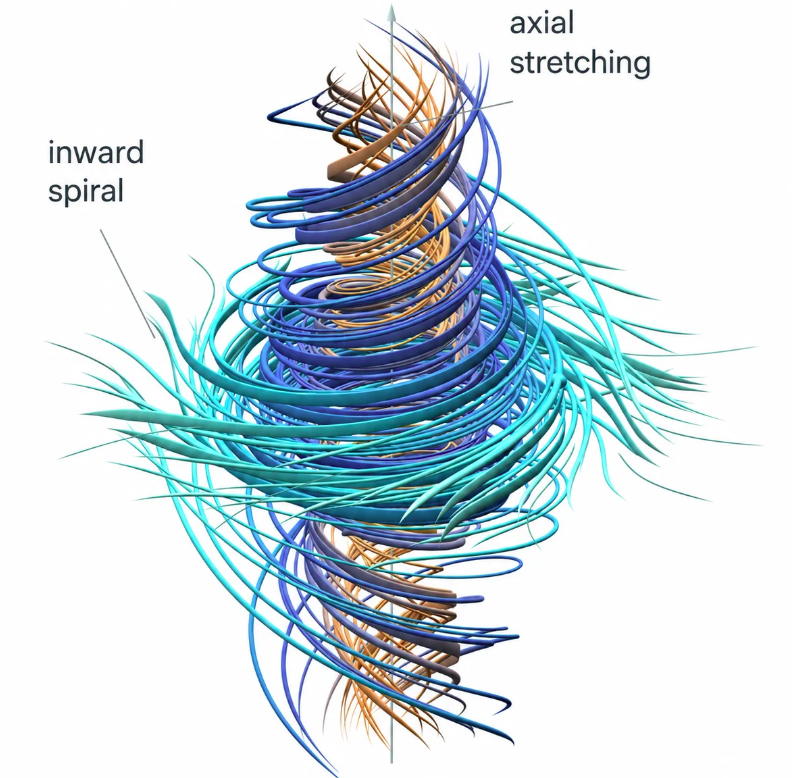
OpenAI said the answer is yes. Its unreleased AI model found that the Navier-Stokes equations can develop a singularity. It means a fluid can start out perfectly smooth, but its motion can shift so extremely that the equations eventually predict an infinite velocity at a particular point. This is despite viscosity, or the fluid’s internal resistance to flow, trying to smooth everything out.
Because a real fluid cannot move infinitely fast, such a singularity would mark a breakdown in the equations’ ability to model the fluid at that point.
Practically, establishing whether singularities can occur helps scientists understand the limits of the equations used in fluid simulations. OpenAI said that if a singularity develops, researchers would have to move beyond treating the fluid as a continuous substance and instead track the behavior of individual particles.
The Navier-Stokes existence and smoothness problem is one of mathematics’ seven Millennium Prize Problems. OpenAI said it doesn’t intend to claim the $1 million prize.
OpenAI said it used a multiagent system powered by an internal model whose training began Aug. 28. Roughly 10,000 concurrent agents worked on the Navier-Stokes effort, sending about 2.7 million messages and generating around 130 billion output tokens. The agents reached the result after about 88 hours, followed by another 17 hours of Lean formalization and verification using GPT-6 Astra.
The experiment was prompted by “rumors” OpenAI said it heard that two Millennium Prize problems had been solved. The company then decided to unleash its model on all open Millennium Prize problems and a few others.