Software companies are taking increasingly aggressive steps to reassure Wall Street as investors question whether AI will strengthen their businesses or undermine the lucrative subscription models that made them some of the biggest winners of the last technology cycle.
The latest example is Figma CEO Dylan Field, who gave up roughly $46 million in stock awards this month because of their potential dilution to shareholders, Bloomberg News reported. His move follows unusual efforts by executives at ServiceNow and Intuit, who earlier this year pledged not to sell shares for the foreseeable future.
Behind the moves is what investors have dubbed the ‘SaaSpocalypse’ – a sharp repricing of software companies amid fears that AI agents and AI-native competitors could erode demand for traditional software applications. Bloomberg reports that software providers that ranked among the market’s most prized companies during the 2010s have lost nearly half their market capitalization from peaks earlier this decade.
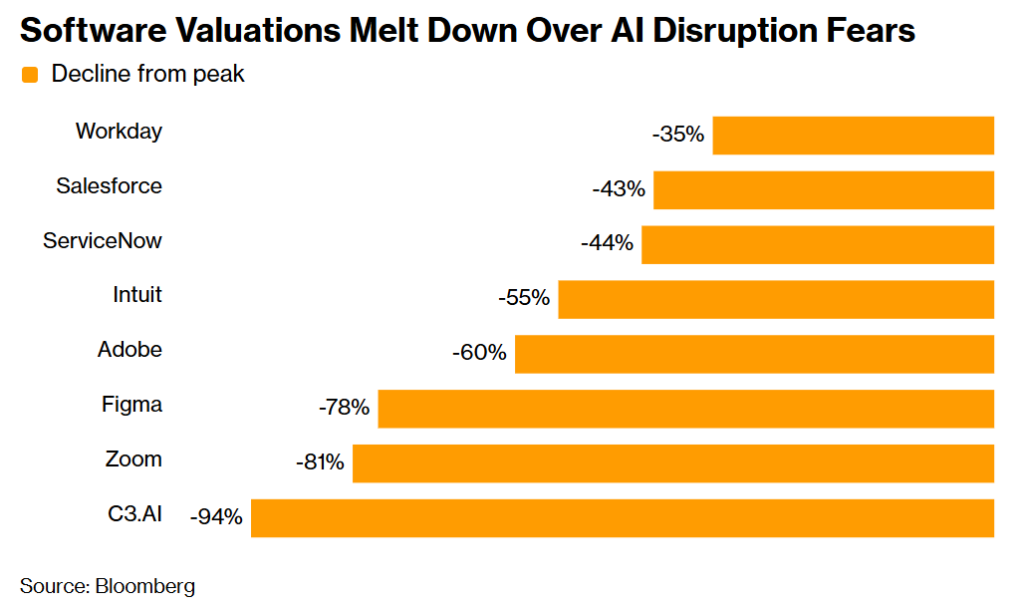
The anxiety persists even as software companies race to introduce their own AI products and argue that the technology represents a new source of growth.
“We think the SaaSpocalypse applies to others but not to us,” Oracle chair Larry Ellison said in March.
That tension is particularly striking at Figma. The company reported second-quarter revenue of $370.1 million, up 48% from a year earlier, raised its full-year revenue guidance and specifically cited AI adoption as one reason for its outlook. CEO Dylan Field said the company sees a larger opportunity as coding becomes commoditized and Figma incorporates agents and coding capabilities into its design platform.
The fundamental problem is not whether incumbent software companies can build AI products. Nearly all of them can. The question Wall Street is asking is whether those products can generate enough new revenue to offset the threat AI poses to their existing businesses.
That could prove particularly important for software companies that historically charged customers according to the number of employees using their applications. If AI agents allow businesses to accomplish the same work with fewer employees – or perform tasks without opening individual applications at all – traditional per-seat software economics could come under pressure.
Some software stocks, including Palantir, Snowflake and Microsoft, have recently recovered as investors see stronger evidence that AI is contributing to growth. Bloomberg reports, however, that the recovery has been concentrated more heavily among infrastructure software providers than application-software companies.