
TLDR
- AI shopping agents are shifting the buying decision from emotional marketing to data-driven evaluation, forcing brands to prove their value to machines as well as consumers.
- Consumer adoption is accelerating: 74% of shoppers would use an AI agent, and nearly one-third would let one choose products within their budgets and preferences.
- To stay competitive, brands must make product information machine-readable and ensure their products deliver on marketing claims or risk being filtered out by AI agents.
For decades, brands have spent billions of dollars fighting for consumers’ attention through advertising, packaging and emotional storytelling.
That strategy is about to face a new kind of customer: the AI shopping agent.
As AI agents begin evaluating products on behalf of consumers, companies will increasingly have to persuade machines to make purchases instead of just people, according to Oliver Wright, senior managing director of industry and enterprise for consumer goods and retail at Accenture.
Convincing a robot necessitates a new approach. Emotional and other marketing appeals may have traditionally swayed human shoppers, but AI agents are far more methodical. In milliseconds, they compare product information, pricing, product claims and other factors, then match it with what they know about the shopper, before recommending a buy. Brands that fail to provide clear evidence of value risk not being considered by the AI agent, even if they’re household names.
“Great marketing has been hiding a multitude of sins. Agents will surface them all,” according to Accenture’s Consumer Pulse Research 2026 report.
In an interview with The AI Innovator, Wright cites the example of a consumer scanning rows of detergent in a supermarket to pick the right one for their needs. Should one pick scented or unscented? HE or not? Store brand or Tide? Big or medium size? Liquid or powder?
“The AI agent cuts through all of that,” Wright said. Faced with a multitude of choices, “very few consumers have the bandwidth and sometimes the math skills to be able to do those sorts of simple comparisons. Even cost per ounce doesn’t get you there in that context.”
The result of using AI agents? “Smarter consumption,” said Wright, who co-authored the report.
Shoppers want to use agents
Lest brands believe consumers aren’t ready to use AI agents, Accenture’s survey showed otherwise.
The report said 74% of shoppers would use an AI agent to shop. Nearly one-third would let an agent decide which products to buy, within predefined budgets and preferences, before approving payment.
Notably, 9% already say they would allow an AI agent to autonomously complete purchases within established restrictions – the most difficult hurdle to get past.
“I think it’s already edging toward 15%” at present, he estimated, since the survey was conducted earlier in the year. “The consumer readiness to operate in this world is way ahead of the industry. This is why we’re calling on both retailers and CPGs (consumer packaged goods companies) to accelerate this because in effect, the consumer is already there.”
Mondelēz, the maker of Oreos, Chips Ahoy!, Cadbury and many other popular brands, is one that is acting quickly, according to Accenture. After finding out that Oreos were only in 10% of AI chatbot cookie recommendations, it rapidly unblocked crawlers agents rely on, restructured its digital presence and made its product content readable by machines – across its product portfolio.
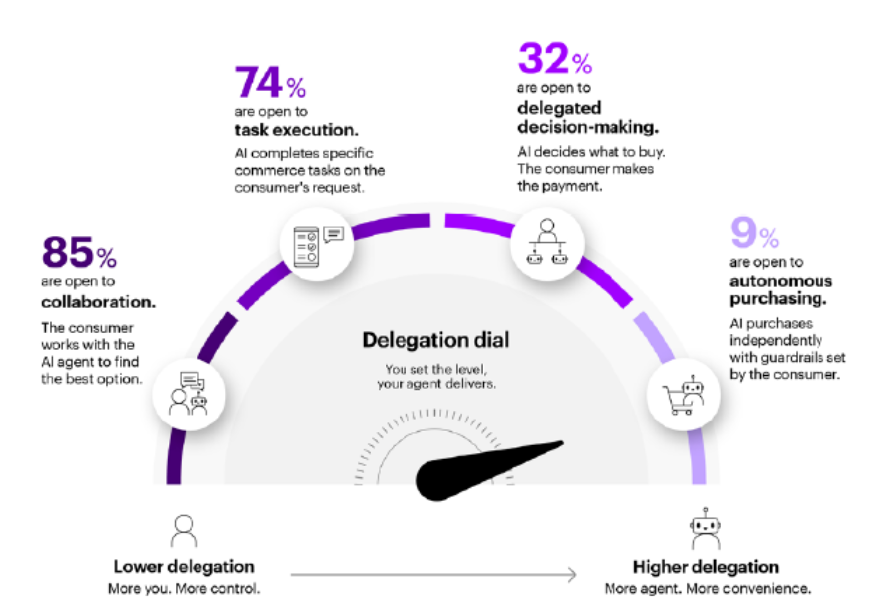
Consumer trust of AI agents is rising. What makes agents especially attractive is that using them can save shoppers time and even money, although agents do exclude many products from consideration after narrowing down options by value and how well it matches a shopper’s preferences.
AI agents can act as personal assistants that understand an individual’s preferences, spending habits and communication style – very different from search or recommendation engines. “That combination of specificity and style of expression is what’s driving that trust factor,” Wright said.
Shoppers also are starting to trust agents because they’re perceived as less biased.
“They are happy to take guidance from a friend or family or social media, but they believe that the agent is more independently acting on their behalf than any of those other sources,” Wright said.
Wright compares the agentic AI transition to the early years of e-commerce, when consumers initially hesitated to shop and enter credit card information online before eventually becoming comfortable with internet shopping. He sees the same trend happening now.
Shopping for one’s better self
In one twist, Accenture researchers expect AI agents to help consumers reach higher personal goals. They will increasingly recommend purchases that align with consumers’ health, wellness and other longer-term objectives. On a diet? The AI agent will recommend healthier food choices.
“It should open up a world where the nature of what human beings are consuming should be better than before, because the tool is truly looking to act on your … enlightened sense of self,” Wright said.
This means the least expensive product doesn’t always win.
“There were clearly examples where AI was nudging you to buy a product that was actually more expensive because it had a stronger long-term value implication for you and it was better for you,” Wright said. “This isn’t just all about a race to the bottom at all.”
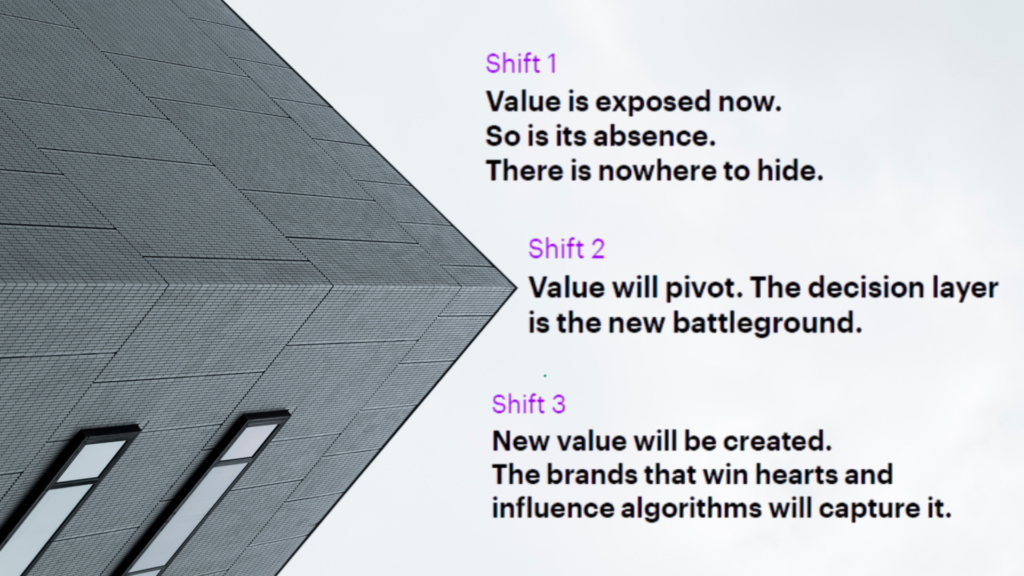
Instead of eliminating brand differentiation, Wright expects AI to create greater market segmentation by matching consumers with products that best fit their preferences.
His three pieces of advice to retail leaders are as follows: Understand how your brand is showing up on general AI agents, such as ChatGPT or Claude, on the AI tools from retailers such as Amazon’s Alexa (renamed from Rufus), and ensure that your products fulfill your marketing promises.
“People have this belief that their product is great. The reality is it’s not,” Wright said. “There are always going to be superior offers in different places.” Under an AI agent’s scrutiny, he added, some companies might have to go back to R&D to improve their products.
Breaking up the one-stop shop?
Accenture’s research suggests AI agents could break apart the traditional one-stop shopping experience by purchasing different items from different retailers. About 60% of consumers said they would like an AI agent to shop across multiple grocery stores on their behalf, for example.
That could reduce retailers from destination shopping experiences to fulfillment providers competing for individual items in a customer’s basket.
As such, success will increasingly depend on whether brands become understandable not only to people but also to AI systems.
“Agents evaluate brands in ways no human does. They parse structured attributes, cross-check verified claims, weigh price-to-value ratios and score fulfillment track records, all in milliseconds, with no emotional loyalty bias,” the report said. “A brand or retailer that has not made its value legible to machines will be invisible at the point of decision, no matter how much consumers love it.”
Companies will need structured product data, transparent pricing, reliable fulfillment and machine-readable product information that allows AI agents to accurately evaluate them. At the same time, they must continue building emotional connections with human customers.
“Brand perceptions are now forming in two places at once: in the consumer’s heart and in the agent’s evaluation,” according to the report. “And the two must hold together.”
Author

Get the latest insights about enterprise AI.
Subscribe to our newsletter. Thank you.