
TLDR
- Enterprise AI token use has surged 2x to 5x, led by coding and customer service use cases.
- Just 9% of enterprises can confidently measure AI token ROI, and most expect spending to keep rising.
- Companies will switch AI models and providers as a way to manage token costs, with many reevaluating their models every quarter.
Listen to this article:
Enterprises have more than doubled their consumption of AI tokens in the past year and expect to keep up the spending, but they are also quick to switch models if prices rise, according to a new Bloomberg Intelligence survey.
Two-thirds of respondents said they have at least doubled their consumption of AI tokens – parts of text processed by AI models to answer user queries – and 92% expect token budgets to increase next year. Coding and customer support were the most common use cases, particularly for financial and retail companies.
“There’s been a 2x to 5x increase in token consumption at the enterprise level,” said Mandeep Singh, Bloomberg Intelligence’s global head of technology research and report co-author, in an interview with The AI Innovator. “That’s why the frontier labs are doing well, that’s why the hyperscalers are doing well.”
Singh estimated that a simple chatbot query could use as many as 5,000 tokens. A coding-agent query might use 100,000 tokens up to a million. An end-to-end agentic workflow could consume 10 million tokens in a single run.
However, despite doubling token usage, only 9% of respondents could connect it to ROI with “high confidence,” the survey showed. As such, they are using other KPIs, such as productivity gains, to justify AI costs.
That finding is one of several disconnects from the survey, which polled 100 senior AI executives at large companies in the U.S. and Europe:
- Companies are willing to swap out AI models for cheaper ones if token costs continue to rise – and 43% reevaluate model providers every quarter. But any savings will go toward using more AI, instead of banking it.
- Open models are still only being used on the periphery. Most companies depend on proprietary models.
Together, the findings suggest enterprise AI adoption is advancing rapidly but much less uniformly than the headlines surrounding agents and new models might imply.
Companies still can’t prove the ROI
According to the survey, nine out of 10 enterprises still cannot confidently connect their AI consumption with financial returns. Only 9% of respondents said they could measure ROI from token consumption with high confidence.
“It’s definitely on the lower side,” Singh said. “There are two very clear use cases where the ROI is evident, but beyond that, it’s still wait and watch in terms of what would be the next big use case.”
Those two areas are coding and customer service. For other applications, companies often rely on other performance metrics.
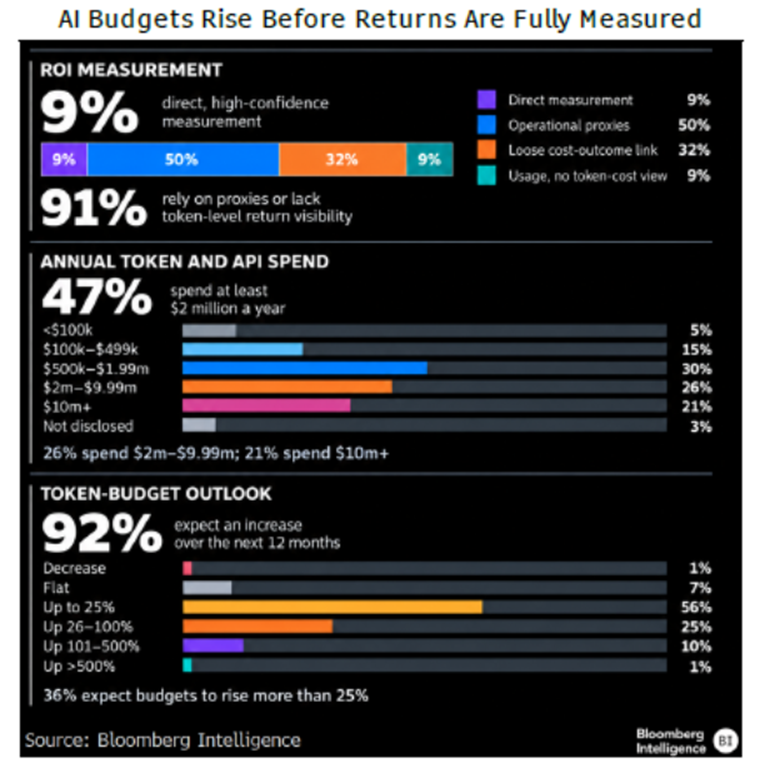
“Mostly all of them are using operational proxies to justify the ROI,” Singh said. “If you take out those two popular use cases around coding agents and customer service, then the rest of that is all experimental.”
That creates a potential constraint on AI adoption. A company considering expanding its token spending must not only determine whether the AI tool can perform the work reliably but whether its benefits justify the additional consumption.
Token spending a small part of IT budgets
Despite the rapid increase in token consumption, AI tokens still account for a relatively small share of technology spending at most companies surveyed by Bloomberg Intelligence.
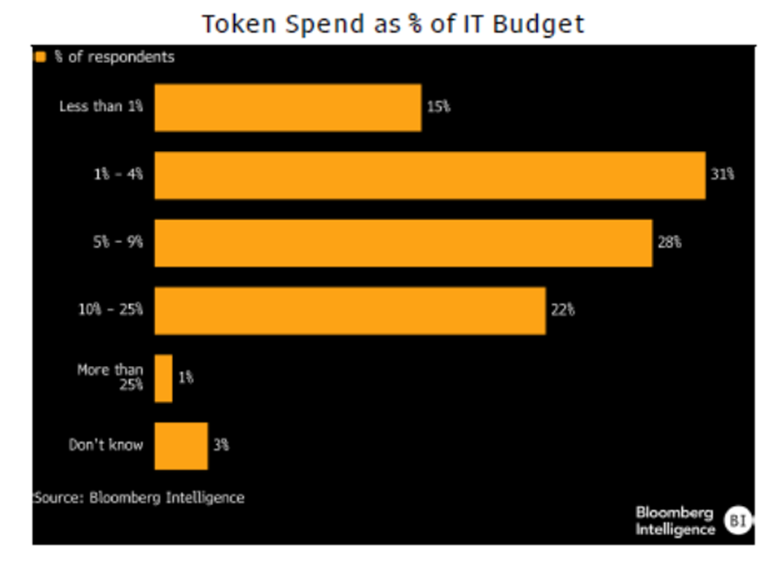
About 20% of companies surveyed is spending at least $10 million on tokens this year. Among technology companies, that figure jumps to 53%. Still, 74% of respondents said token spending represents less than 10% of their total IT budgets. And within this group, 31% put token spending at between 1% and 4% of their IT budget.
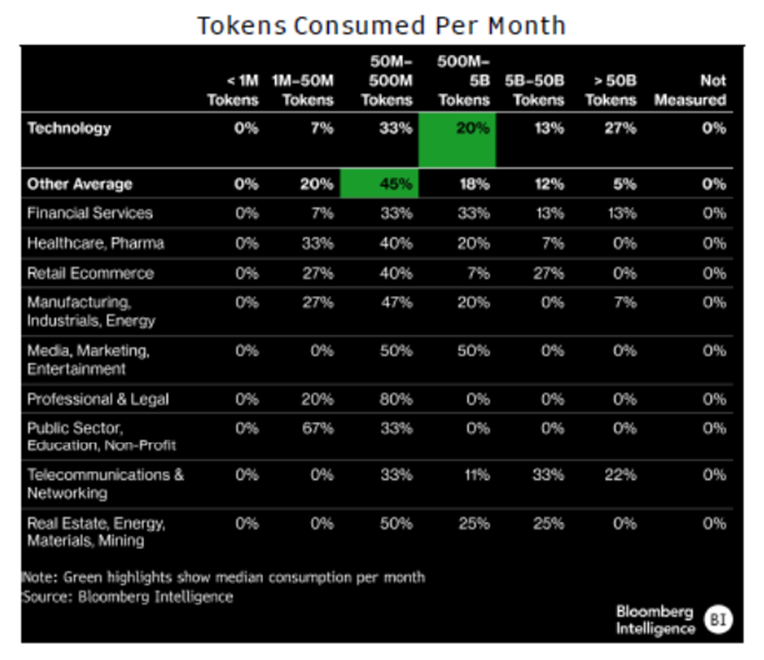
In terms of volume, the median company excluding technology firms consumes between 50 million and 500 million tokens a month, according to the survey. Technology companies consume substantially more: The median is 10x higher, in the 500 million to five billion token range. Meanwhile, 25% of technology respondents consume more than 50 billion tokens monthly.
Still, the relatively small percentage AI tokens take up in the IT budget has helped enterprises absorb extraordinary increases in usage. But Singh said this will become harder as the base grows.
“I think budgets don’t grow more than mid- to high-single digits. You’re talking 5% to 7% increases,” Singh said. “So if something is growing 200% to 500% you’ve got to find something else to cut.”
That may explain why companies expect their AI token budgets to keep rising but at a slower pace than consumption. Singh said 56% expect token budgets to increase by 25% over the next 12 months.
Open models aren’t popular
The survey found another trend that may run counter to conventional wisdom: Open models are far from becoming the standard choice for enterprises.
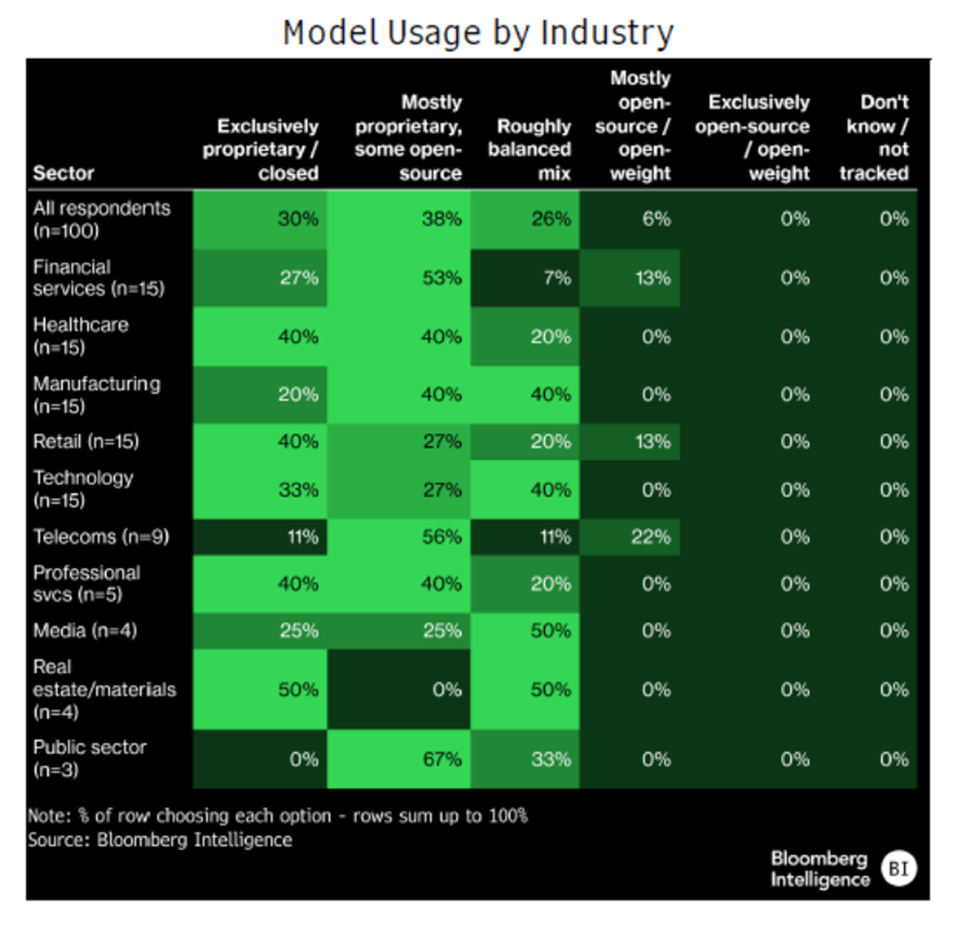
Only 6% primarily use open models and none use them exclusively. That compares with 68% of respondents relying exclusively or primarily on proprietary models.
The obstacle isn’t simply model performance. Running open models can require companies to customize, fine-tune and host them themselves – capabilities that many enterprises may not have.
“Even for large enterprises, it’s hard,” Singh said. “They’re not as sophisticated as a Cursor (SpaceXai’s coding firm) or Harvey (legal AI startup), so that’s where the challenge lies: It’s in overcoming that friction to be able to customize these models and run them on premises.”
The survey shows that most respondents access AI through cloud-hosted or commercial APIs, meaning they don’t have to run the models themselves.
Cost is another hurdle. Although open models can be downloaded without the per-token charges associated with proprietary models, companies still incur the computing and infrastructure costs required to run them. Singh said open models need to be at least 50% cheaper than frontier proprietary models to justify the additional complexity.
Model loyalty is weak
Companies may favor proprietary models today, but Bloomberg’s findings suggest that doesn’t translate into strong loyalty to any particular provider.
If token prices increased 50%, 84% of respondents said they would switch models or optimize their usage. However, only 13% would cut AI use, pause deployments or greatly scale back initiatives – signaling robust demand. “It’s another sign that executives know they simply can’t forego AI usage, even as costs rise,” according to the report.
If prices fell by half, 86% would increase AI usage. Notably, 43% of companies reevaluate their AI model providers every quarter.
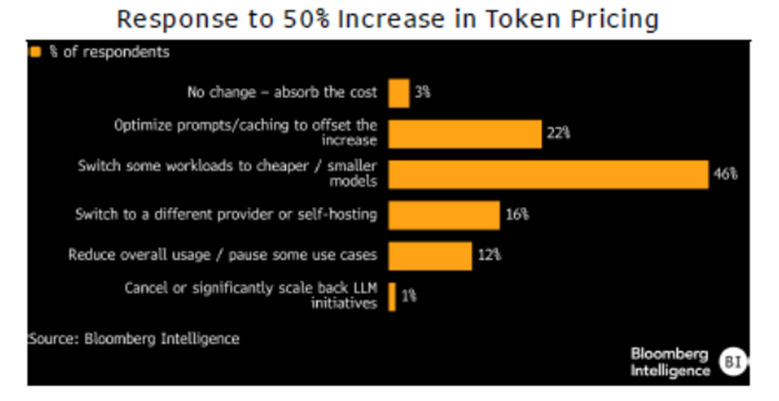
Businesses are already shopping around inside their AI workloads. Fifty-five percent route requests to cheaper models. They are also using cost control techniques such as prompt optimization, batching, rate-limiting, usage quotas, prompt or response caching, fine-tuning and distillation.
Price sensitivity could become increasingly important as AI shifts enterprise software economics away from predictable per-user subscriptions toward metered consumption.
Sixty-three percent of respondents primarily access models through cloud-hosted or commercial APIs. Including hybrid users, 82% use APIs, meaning the cost of AI increasingly rises with the amount of work performed rather than simply with the number of employees licensed to use software.
Enterprises expect token pricing to change in the next two to three years: 61% expect prices to stay stable or decrease – in this group, 35% believe prices will drop 10% to 50% in two to three years. There are companies that expect prices to rise: About a third think it will increase moderately (10% to 50%) or significantly (more than 50%).
However the cost structure shakes out, the survey showed there’s plenty of enterprise AI demand ahead for model developers and hyperscalers.
“That’s a sign of a very solid demand that is going to carry through, barring some big change in the macro setup,” he said.
Author

Get the latest insights about enterprise AI.
Subscribe to our newsletter. Thank you.