
TLDR
- Amazon open-sourced Kiro Crew after the internal AI tool went viral with more than 39,000 employees adopting it in less than six months.
- Unlike typical AI coding assistants, it coordinates multiple AI agents and remembers work across sessions.
- The tool includes enterprise security controls and is open source so developers can extend it.
A new AI tool developed internally by three Amazon engineers as a side project has become so popular among employees that the tech giant decided to release it as open source on GitHub.
Called Kiro Crew, the software acts more like a project manager than a chatbot. Most AI coding assistants stop working when a chat session ends. Kiro Crew keeps working on tasks in the background and remembers previous work, so users can pick up where they left off the next time they fire it up.
In less than six months, more than 39,000 Amazon builders have used it and over 500 Amazon employees have contributed to it, according to the company. Releasing it as open source preserves its community-driven origins while allowing outside developers to extend it, AWS Distinguished Developer Advocate Darko Mesaroš said in an interview with The AI Innovator.
“It’s an orchestrator that takes your agents and makes them do stuff,” he said. “One of the critical elements of software development these days is not sitting in front of a single prompt, a single agent, a single chat window, and telling it what to do. You have different elements working together – multiple agents working on different pull requests, different issues collectively – to achieve your goal.”
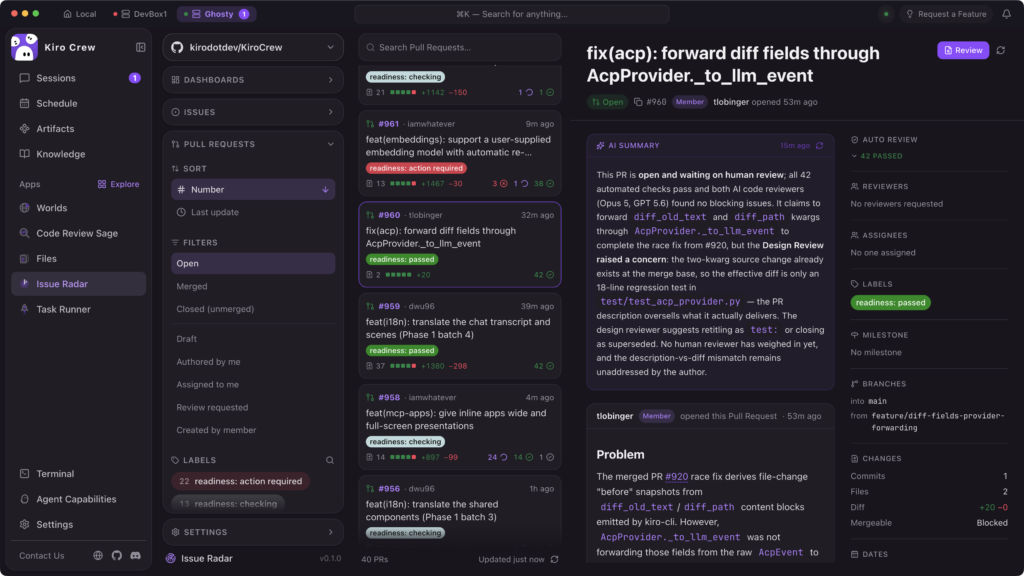
Kiro Crew manages multiple AI agents, remembers past interactions and continues working on tasks. Instead of asking an AI to write a piece of code and waiting for the answer, a developer can assign a larger job – such as fixing software bugs, monitoring code tests or reviewing several projects – and let Kiro Crew coordinate several specialized AI agents that continue working in the background.
Mesaroš said security was a key design goal because Kiro Crew manages AI agents that can access code and development tools. Kiro Crew also lets developers run it on hardware they control, inspect its memory and review the actions it takes. Users can also require approval before the software uses certain tools or accesses sensitive resources.
Kiro Crew can schedule recurring jobs, monitor code repositories for changes, retry failed tasks automatically and build a memory of a user’s preferences over time. Corrections become “lessons,” and repeated work patterns can become reusable “skills” that the system suggests for future tasks.
Once Kiro Crew went viral internally, AWS realized that it was something clients could use so the tool was released to the public.
“Since it was built as a grassroots movement internally, we wanted to make sure that it’s (open source) so folks or builders out there can actually make changes and add new features to it for the benefit of everybody,” he said.
While Kiro Crewe is open source, Kiro – the AI coding environment – remains proprietary.
Kiro Crew also supports communication through channels such as Slack, Telegram and Discord, enabling users to check on long-running work without returning to their development environment.
Author

Get the latest insights about enterprise AI.
Subscribe to our newsletter. Thank you.