
TLDR
- Companies are increasingly concerned about AI costs and largely ditching the practice of “tokenmaxxing,” but they are not slowing down AI adoption, according to Traci Gusher, EY Americas AI and data leader.
- AI is changing the build-or-buy equation as companies increasingly vibe code custom software in-house. But DIY software brings its own governance, cybersecurity and maintenance challenges.
- Gusher believes companies will still buy a “skinny” core software system such as CRM or ERP, but surround it with custom AI-built in-house software tailored to their needs.
For much of the past three years, many companies pursued a straightforward AI objective: Get more employees to use it.
Executives urged their staff to experiment with chatbots, coding assistants and AI agents. Some organizations even tracked token consumption or AI usage as a measure of adoption, encouraging a practice dubbed as “tokenmaxxing” – the push to use as many tokens as possible to demonstrate that AI is being widely adopted.
Now, that mindset is changing.
It turns out that every prompt, code generation request or AI agent action consumes tokens, which charge by the number used. These costs can rack up quickly. The result is a new management challenge: How to rein in costs while continuing to enjoy the benefits of AI.
“Senior leaders are having a growing level of consternation and concern with the costs of AI and AI tokens,” said Traci Gusher, EY Americas AI and data leader, in an interview with The AI Innovator. “They’re very concerned about the ability to manage token costs.”
Gusher has even seen organizations put up boards tracking how many tokens people used. Upon seeing it, she thought, “Why are we rewarding people for spending money without rewarding them for the use or the value coming out of spending that money? I think that realization is starting to land pretty strongly with the organizations and leaders that we surveyed.”
Gusher’s comments reflect a broader shift documented in EY’s fifth AI Pulse Survey, which suggests enterprise AI has entered a more financially disciplined phase. The survey, which Gusher co-authored, found that 82% of senior leaders whose organizations invest in AI are “concerned” about token costs, while 98% say those costs have caused them to “reconsider” their approach. Yet only 64% report actively monitoring token usage and maintaining budget guardrails.
The bill comes due
The shift comes as several high-profile companies have publicly acknowledged that AI inference costs are becoming difficult to ignore.
Uber became one of the earliest examples of a company becoming cost-conscious about AI token usage. It had burned through its AI coding budget well ahead of schedule, resulting in employees being given a $1,500 monthly spending cap per AI coding tool, according to Bloomberg Law.
Uber CTO Praveen Neppalli Naga said the company is moving beyond its “tokenmaxxing” era, according to Business Insider. Although Uber has sharply increased AI adoption, it is now reining in AI costs by using cheaper models, prompt caching and improving its monitoring of AI spending.
This new market dynamic is reflected in OpenAI’s recent announcement that its GPT-5.6 family was designed to deliver more work per token, with its Terra model matching GPT-5.5 on intelligence benchmarks at half the price and its lower-cost Luna model priced 80% below flagship GPT-5.6 Sol. The startup said it achieved the efficiency gains through improvements to its models, inference infrastructure and agentic software.
Meanwhile, companies are realizing they don’t need the latest and most advanced AI models for every task. “If it’s too expensive and there’s an alternative, (they will use it) even if it’s not quite as good,” Gusher said. “Perfect is the enemy of good enough.”
Despite concern for costs, there are more companies broadening their AI deployment than cutting back. The EY survey shows that 37% plan to expand their AI deployment while 15% plan to pull back; 29% plan to speed up deployment and 15% will be slowing it down.
Collapsing the software development cycle
The economics of AI are also reshaping enterprise software strategies.
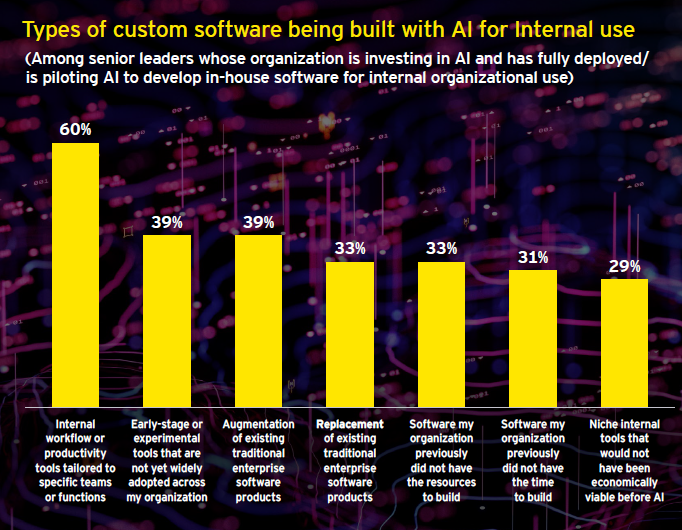
Nearly nine out of 10 senior leaders say their companies are building their own software in-house using AI, while 76% of say traditional off-the-shelf software no longer fully meets their organizations’ needs, the survey showed. Meanwhile, 91% say in-house software built by AI reduces their dependence on enterprise software vendors.
“Because the ability to build software is getting easier, and you need less technical resources to get the same job done, there are a lot of organizations that are questioning, ‘do I buy the software that’s off-the-shelf and available to me but I will be held in handcuffs to the development roadmap of that software, or do I just build it myself?’” Gusher said.
Previously, organizations accepted vendor lock-in because developing bespoke applications was too slow and expensive.
“The speed and the cost to developing your own software was too high and too slow,” she said. “That’s changed dramatically.”
It also goes beyond vibe-coding – the practice of using everyday language to instruct AI to generate or modify software code. Gusher said organizations are redesigning entire software development lifecycles: from product idea to design, coding, testing and launch. AI can collapse these activities so they can happen simultaneously.
“All of those things can be happening in parallel,” Gusher said. “You can connect the entire cycle of development into a process that is more efficient, and in some cases, even higher quality than it was before.”
Shake-up, not SaaS-pocalypse
That means AI is bound to change the business model of software vendors. EY’s survey showed that four out of 10 companies plan to use in-house models and tools to augment services from software vendors, while 31% plan to replace these vendors with their DIY systems.
In five years, 82% believe the software vendors’ pricing model of charging by the user will be less relevant.
But senior leaders also report problems when building their own software. These include higher risk of employees using unauthorized AI; their models or tools not having adequate governance or guardrails or not being resilient against cyberattacks; incurring higher initial costs, lack of in-house talent, concerns about accuracy or reliability, and the need for ongoing maintenance and support.
As such, Gusher sees companies maintaining basic CRM or ERP software, augmented by custom, in-house models or tools designed specifically to meet their unique needs.
“It’s the idea of having this skinny core of an ERP system, this skinny core of a CRM system, and so on,” she said, “and then customized software all around the edge that is actually running your business.”
Software vendors must then ask themselves, “How can I provide a product that has the maximum level of flexibility to the end user and they are not as locked into exactly the way this operates?” she said. “Is there a way to make it custom without changing the core of what this product does?”
The changing face of software development is one part of a broader transition that generative and agentic AI are bringing to organizations. Today, companies are at a crossroads: Should they continue to drive AI usage or pull back due to cost concerns? Should they cut jobs and put the savings into AI, or add jobs and do more with AI? Should they seek to minimize spending or maximize the value of AI?
“The duality of AI – that it makes everything easier and seemingly more complicated at the same time – is embedded in its value proposition,” the authors of EY’s survey wrote. “The fact that it doesn’t neatly slot into today’s operations is why it’s so powerful.”
Author

Get the latest insights about enterprise AI.
Subscribe to our newsletter. Thank you.