TLDR
- Nigeria has about 15 to 25 data centers in operation, second only to South Africa in the continent.
- Three major data center projects underway in Nigeria are Kasi Cloud’s campus in Lekki, Airtel’s Nxtra site at Eko Atlantic and Open Access Data Centres’ expansion in Lekki.
- Unreliable electricity, a shortage of skilled engineers and slow demand for AI computing are holding the market back.
Nigeria is joining the global AI boom, with several data centers built for AI hardware opening or scheduled to come online over the next few years.
Nigeria is Africa’s most populous country, with more than 220 million people, and almost all of the new projects are in Lagos, its largest city and commercial center. Lagos already hosts nearly three-quarters of the country’s commercial data center capacity, according to Olatubosun Alake, the Lagos State commissioner for innovation, science and technology. He said about 146 MW more is planned and that the state wants to have more than 250 MW by 2030.
Data center size is measured in megawatts, the amount of electrical power a facility can deliver to the servers inside. Halls built for AI need more of it per rack, because a rack of GPUs – the chips that train and run AI models – can draw several times the power of a rack of ordinary servers.
Three major data center projects
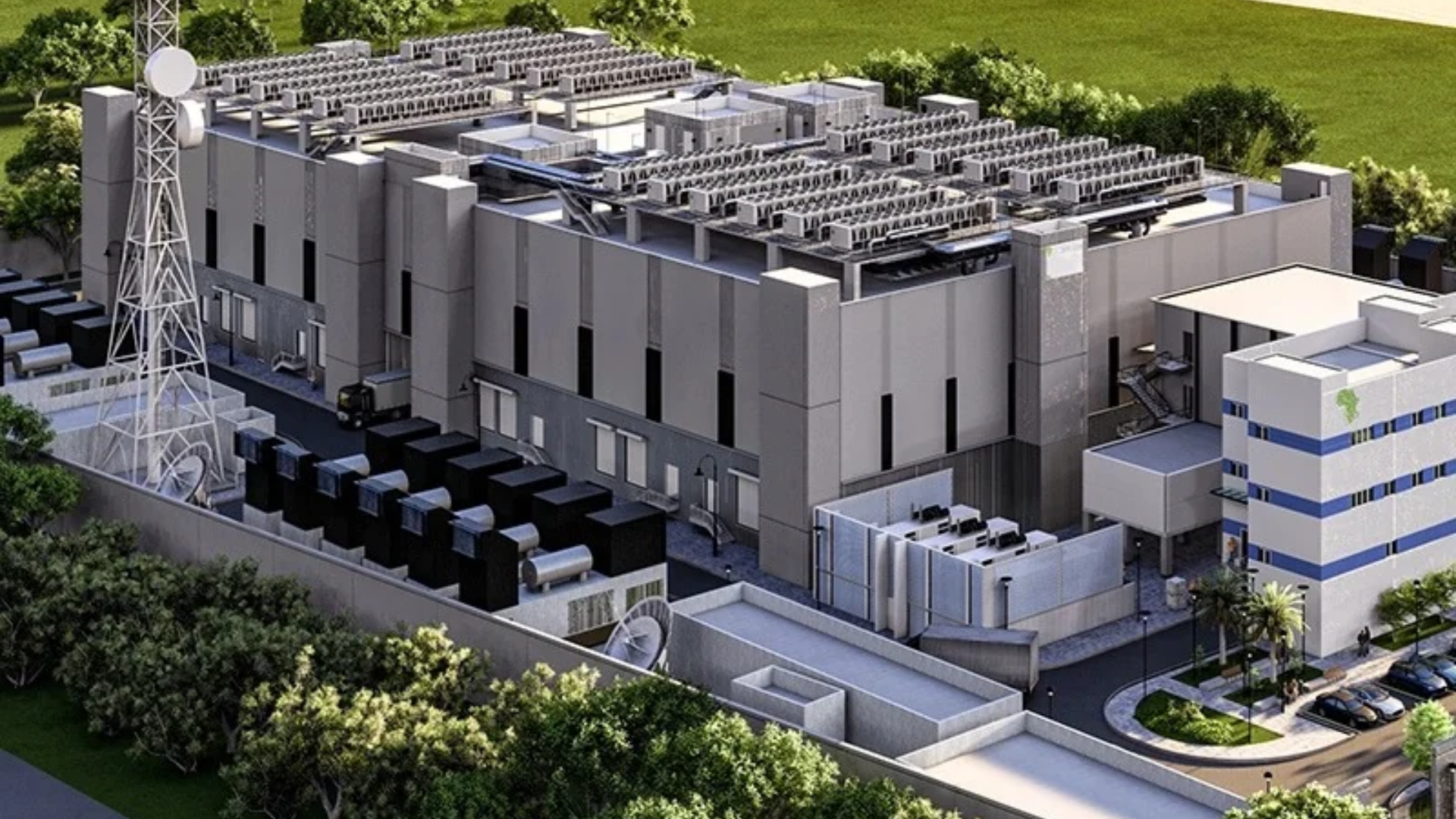
In May, Kasi Cloud Datacenters opened the first phase of its campus in Lekki, a peninsula district east of central Lagos. Lagos State Gov. Babajide Sanwo-Olu officiated the flag-off. The roughly four-hectare site sits near six subsea internet cable landings, including Google’s Equiano and the Meta-backed 2Africa, and Kasi said it is designed to grow to 100 MW at a cost of about $250 million.
Its first phase is a 5.5 MW data hall plus a 7.5 MW floor for colocation, cloud and network customers. Alake said at the launch that the facility includes Nvidia H100 and H200 GPUs. Kasi hasn’t said how many; TechCabal reported that it was 7.2 MW of IT load on a campus designed for 40 MW. The Nigeria Sovereign Investment Authority, the country’s sovereign wealth fund, invested $8 million through a convertible loan note.
Nxtra by Airtel, the data center arm of the telecom operator Airtel Africa, broke ground at Eko Atlantic, a reclaimed-land development off Victoria Island, Lagos’s main business district, in March 2024. Airtel Nigeria is building a 38 MW facility costing more than $120 million, designed for racks drawing up to 25 kilowatts, and said in August 2025 that the first batch of GPU servers had been delivered. Airtel originally aimed for the first quarter of 2026. A February report said operations had begun while power systems were still being tested, and the tracker Coloprice still listed the site as under construction on Oct. 1.
Open Access Data Centres, or OADC, part of the pan-African fiber company WIOCC, runs the Lekki facility where Google’s Equiano cable lands. After it filled its first 1.5 MW building, OADC said in March 2025 that it would spend up to $240 million to take the site to 24 MW by 2027. CEO Ayotunde Coker put the cost of high-reliability Tier III capacity at about $10 million per megawatt and cautioned that projects like this usually take more than two years.
Two other big projects have no public timelines. MTN Group, Africa’s biggest mobile operator, said in August that a new venture with Dubai-based developer Tarek Al Ashram would build 150 MW of AI-ready capacity across South Africa and Nigeria, with no sites or dates announced. Lagos-based company 21st Century Technologies has said it’s building a 50 MW facility in Ikeja, the Lagos State capital, and hasn’t given a completion date.
Where Nigeria stands now
Nigeria has about 15 to 25 data centers, depending on who’s counting. Xalam Analytics, in a January market brief for the EU-funded Digital for Development Hub, counted about 15 live commercial data centers with about 28 MW of live IT load in 2025, plus about 45 MW under construction. The industry directory Data Center Map listed 25 facilities as of February. The largest operator by live capacity is Rack Centre, with 13.5 MW across two buildings in Ikeja.
Most of the country’s computing still happens abroad. Kasi estimates that Nigerian organizations spend about $850 million a year on foreign cloud services. None of the big U.S. cloud providers has a full cloud region in Nigeria. Amazon Web Services opened a smaller Local Zone in Lagos in 2023, but its only full African region is in Cape Town, and Microsoft Azure’s African regions are also in South Africa. Most Nigerian AI startups run their workloads on AWS, Google Cloud or Azure servers outside the country and pay in dollars, Techpoint Africa reported in March.
Within Africa, Nigeria ranks second in number of data centers, behind South Africa. Data Center Map’s February listings put South Africa at 61 facilities, Nigeria at 25 and Kenya at 19. Xalam calls Nigeria the second-largest commercial colocation market in sub-Saharan Africa. South Africa accounts for more than 60% of the continent’s operational capacity, according to a July report by the consultancy Fortren & Company, and Africa as a whole holds roughly 0.6% of global capacity, according to the Africa Data Centres Association.
Opportunities and hurdles
Data centers create a lot of construction work and few permanent jobs. A December 2025 report by Verraki Partners, a member of Andersen Consulting, estimated that a 1 MW Tier III facility creates about 700 construction jobs and 20 to 30 full-time operating roles. Airtel has said Nxtra would employ about 1,000 people during construction and keep 250 permanent staff. Rack Centre’s 13.5 MW campus has about 65 full-time employees, according to TechCabal.
The AI computing opportunity is still small. The government’s Nigeria AI Scaling Hub, launched in June 2025 with up to $7.5 million from the Gates Foundation, runs on a single server with eight Nvidia H200 GPUs in Abuja, the capital. That’s enough for a startup fine-tuning a model or a ministry testing a chatbot.
N-ATLAS, Nigeria’s open-source language model for English, Hausa, Igbo and Yoruba, was built by fine-tuning Meta’s Llama 3 8B, a job that takes a small fraction of the computing power needed to train a model from scratch. Rack Centre’s 12 MW LGS2 building can take racks drawing up to 70 kilowatts, but no customer has brought an Nvidia GPU cluster there yet, Adebola Adefarati, Rack Centre’s head of marketing and communications, told The AI Innovator. He said companies selling GPU time as a service are due to set up at the facility soon.
Electricity is one of the biggest operating expenses. Nigeria has about 13,000 MW of installed generating capacity, but the national grid usually delivers 4,000 MW to 5,000 MW for the whole country and collapsed three times in the first nine months of 2025. Lagos receives less than 1 GW of that, the state’s energy commissioner said in August.
Data centers that promise customers near-constant uptime can’t rely on that supply, so most build their own power plants. Rack Centre runs on a gas plant it owns, with diesel backup, and has never connected to the grid, Adefarati said. Power from diesel generators costs $0.28 to $0.33 per kilowatt-hour, about six times what Nigerian businesses on the grid paid on average in the third quarter. Operators pass that cost on to customers.
The newest campuses are adding grid connections to their own generation. Kasi has a direct 132-kilovolt power line alongside gas generation, solar power and battery storage. Tetracore Energy Group, a gas company, plans to run a $400 million, 20 MW data center in neighboring Ogun State from a 100 MW plant onsite.
The nearest new business comes from the Central Bank of Nigeria. On June 15, it ordered banks, fintechs and other payment companies to store and manage payment transaction data inside the country by Jan. 1, 2027. Much of that data now sits with foreign cloud providers.
Bank and payment executives have questioned whether they can move live systems in time, and a central bank official said at an industry meeting in Lagos that the deadline hadn’t changed. Most of that work is storage and transaction processing, which doesn’t need GPUs.
Rack Centre already hosts some of the largest banks and fintechs and has spare room on its campus, Adefarati said. Asked whether it could take all the data that may move by January, he said he “would like to think” so.
Skilled staff are scarce too. In an Africa Data Centres Association survey cited by TechCabal, 67% of Nigerian operators named keeping trained staff as a major challenge. Adefarati told TechCabal that engineers who learn to run reliable systems in Nigeria “become prime targets” for employers abroad. Kasi CEO Johnson Agogbua told BusinessDay in February that training and keeping specialist engineers could become a bigger bottleneck than power. Rack Centre started a subsidized training academy in April with an initial class of 15 to 20 engineers.
Why AI demand is weak, and what could change it
Nigerian companies are still in the early stages of AI adoption, Adefarati said. Banks are testing it for fraud detection and transaction workflows, and the banks, telecom operators and other companies that have talked to Rack Centre about GPUs want three or four racks at the most. Asked whether weak demand or import rules were the bigger obstacle, he said demand.
Foreign AI companies also have little reason to run their models from Nigeria, he said, because the country doesn’t require it. The federal government’s National Digital Cloud Policy, unveiled in August, sets data residency rules for government and regulated data and doesn’t require private companies to keep commercial data in the country. Expensive local power adds to the price of hosting in Lagos. Nigerian startups that train models generally do it on foreign clouds and run lighter workloads at home, according to Techpoint Africa.
Demand for ordinary data center space is stronger. Xalam puts occupancy in Nigeria at about 70% of available capacity. Across Africa, only about one-third of built capacity is in use, according to the Africa Data Centres Association’s 2026 report, which names weak power infrastructure and thin demand among the main constraints. The Nigerian figure suggests the country’s shortfall is in demand for AI computing, not data center space overall.
Several proposals aim to raise demand. The National AI Strategy, which would direct public money toward computing, was awaiting approval by the National Assembly in March. At an AI infrastructure conference in Abuja on Oct. 21, Olubunmi Ajala, national director of the National Centre for Artificial Intelligence and Robotics, proposed that African countries pool their computing resources for large AI workloads, and pointed to a planned Nigeria-Togo data park.
Xalam’s brief notes that the government is offering pioneer tax status to attract the big cloud companies. The Verraki report recommends pre-negotiated electricity tariffs and long-term power contracts for operators, special zones near fiber routes, and training programs for data center staff. Rental GPUs could also lower the cost of entry for smaller companies.
Why local AI data centers matter
Companies building local capacity argue that it makes Nigerian services faster and cheaper to run. Sending traffic to servers outside the country adds about 70 to 90 milliseconds per round trip, compared with under 5 milliseconds from a Lagos facility, according to Techpoint Africa.
For an AI system answering users as they type, that delay may be noticeable. Kasi pitched its campus as a way to keep part of the $850 million a year that Nigerian organizations spend on foreign cloud services in the country, money that’s mostly paid in dollars.
Regulators are pushing in the same direction. The central bank’s payment rule requires transaction data to stay onshore, and Nigeria’s Data Protection Act of 2023 sets conditions on sending personal data abroad. Government data falls under the residency rules in the cloud policy. Each rule gives banks, telecom companies and public agencies a reason to keep more of their computing at home.
What comes next
Forecasts for the next few years vary widely. The real estate research firm Estate Intel projects Nigerian capacity will pass 218 MW by 2030. Verraki expects more than 400 MW within three to five years, and the Lagos government is aiming for more than 250 MW in Lagos alone by 2030. All of those numbers depend on cheaper and steadier power, on lawmakers passing the AI strategy and on Nigerian AI companies growing large enough to rent whole halls of GPUs.
Operators are building with caution. Rack Centre’s first 1.5 MW facility took about 10 or 11 years to fill, Adefarati said, and “you don’t want a situation where you build facilities and they sit empty.”
For AI itself, the near-term outlook is modest. There’s no public record that lawmakers have approved the national AI strategy, the government’s shared computing hub runs on a single eight-GPU server, and Nigeria’s own language model was adapted from Meta’s rather than built from scratch.
Startups that train models mostly do it on foreign clouds. Until Nigerian AI companies need much more computing power at home, the nearest new business for the country’s data centers comes from banks bringing payment data onshore, not AI labs.
Author

Get the latest insights about enterprise AI.
Subscribe to our newsletter. Thank you.