
The most recent survey of CXOs by Sierra Ventures debunks several widely held views about how enterprises are deploying and funding AI. Here’s what the VC fund’s CMO Anne Gherini had to say about some of those beliefs.
Myth No. 1: AI deployment is mainly a technical problem.
The survey showed that 73% of CXOs believe organizational mindset is now the biggest obstacle to AI adoption.
That suggests companies have largely stopped asking whether GPT, Claude or Gemini are capable enough. Instead, they’re struggling to change decades-old workflows built around human decision-making. The bottleneck has moved from the model to the organization.
“Organizational mindset was the number one main issue, overwhelmingly chosen, as hampering AI deployment,” Gherini said in an interview with The AI Innovator. “The bigger the org, the more established it is, the harder it is to get everyone on the same page.”
Notably, their belief stands in contrast to the hands-on view of engineering leaders, who pointed to bad data and missing evaluation frameworks instead as the biggest culprits.
Myth No. 2: Companies are turning AI agents loose.
The headlines suggest autonomous AI agents are arriving everywhere. The survey tells a more cautious story.
While almost everyone – 97% – is using agents, 43% limit them to low-risk workflows and 33% require human approval. Only 20% trust them enough to operate broadly without human oversight.
Companies trust AI most where mistakes are measurable and reversible – writing code, testing software and internal IT. The issue isn’t capability. It’s trust.
Myth No. 3: AI budgets are funded by money saved from layoffs.
Nearly every company surveyed is increasing AI spending. But only 3% said layoffs are the primary source of that money.
Instead, organizations are creating new AI budgets (41%) or shifting money away from IT projects (32%), professional services (15%) and software vendors (12%).
That sharply contrasts with public perception that AI investment is primarily being funded through workforce reductions. Still, hiring for entry level roles might be impacted for now as AI advances, and jobs could increasingly require AI proficiency.
“I think we’re in that transition,” Gherini said. “That entry-level role … in the short term it might be going away. In the long term, it’s just going to shift and change.”
Notably, several respondents called out “AI washing” by companies that over-hired in the past and now are cutting jobs and labeling the layoffs as efficiency driven by AI.
Myth No. 4: Enterprises are relying heavily on AI vendors.
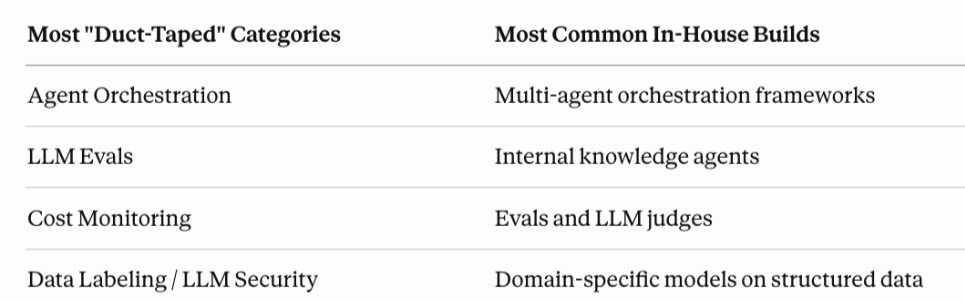
The survey suggests the opposite. Companies are increasingly building critical AI infrastructure themselves as advanced coding tools empower their own engineers.
They’re building their own AI systems, especially in areas where off-the-shelf solutions don’t meet their needs.
The most “duct-taped” categories are agent orchestration and LLM evaluations, according to the survey. For agent orchestration, the complaint is “there is no good standard. Every team is wiring together its own multi-agent framework with no durable tooling underneath.”
For LLM evaluations, the problem is that “systematic, scalable eval infrastructure does not exist for most teams, particularly for domain-specific tasks where generic benchmarks are meaningless.”
Author

Get the latest insights about enterprise AI.
Subscribe to our newsletter. Thank you.