PARIS – European industry may hold one of the continent’s strongest cards in the artificial intelligence race: decades of proprietary industrial data, deep engineering expertise and some of the world’s largest manufacturing companies.
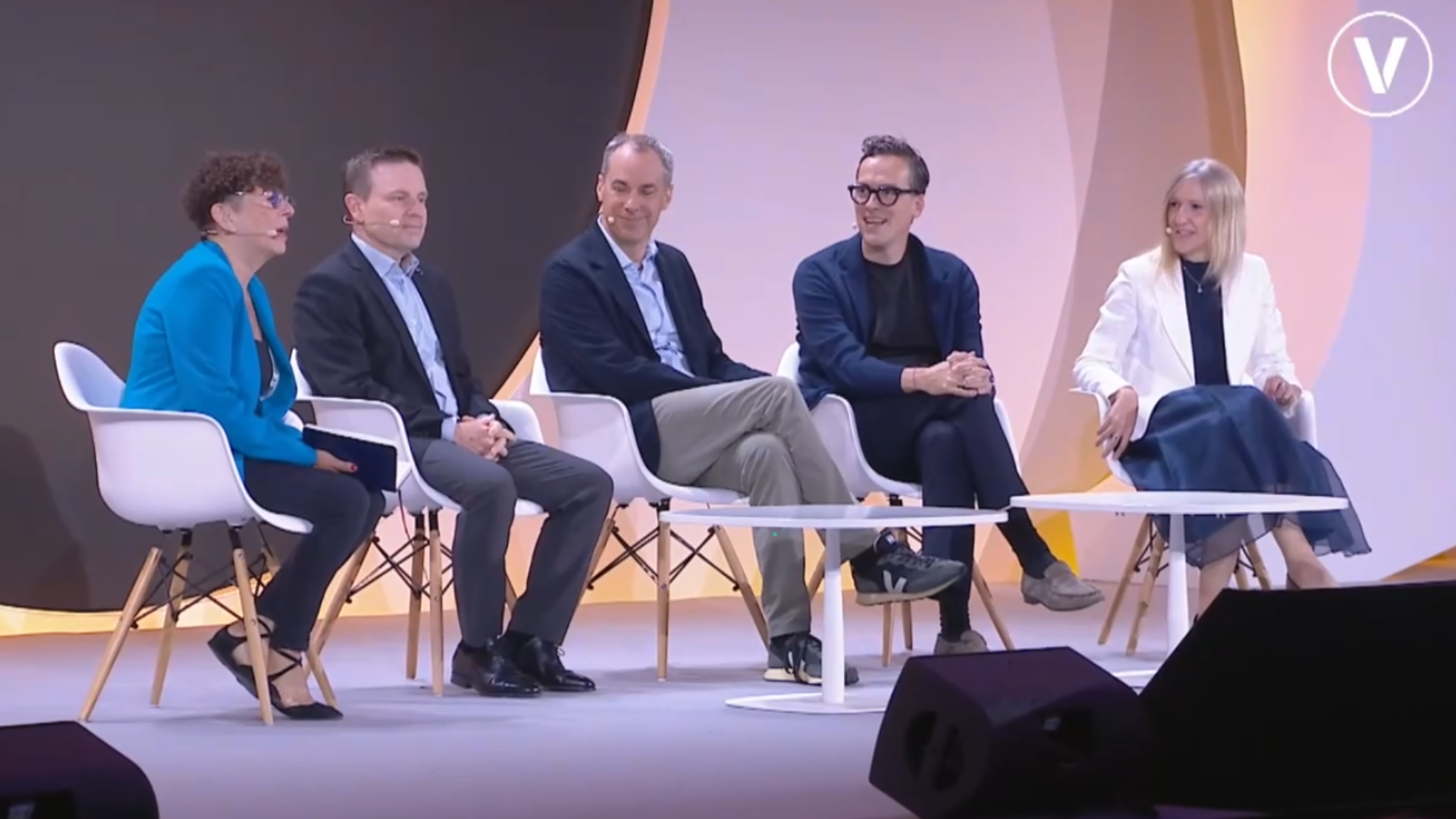
That was the message from executives at SAP, Siemens, Volvo Group and powerhouse startup Mistral AI during a panel discussion at the VivaTech conference, which sponsored The AI Innovator‘s trip.
They argued that Europe can carve out a competitive position in AI by focusing on industrial applications rather than trying to replicate consumer AI successes from the U.S. and China.
“It’s a (pivotal) moment here in Europe for industrial AI and industrial companies to turn this IP into an advantage,” said Marjorie Janiewicz, chief revenue officer of Mistral AI.
Janiewicz said European manufacturers possess vast stores of operational, engineering and production data that can be transformed into competitive advantages when combined with large language models. She said keeping that data within Europe is critical to maintaining sovereignty and control over future innovation.
“Those systems can be deployed in Europe,” she said. “Have the data stay home and own your future.”
Mistral is already working with companies including Airbus and BMW on industrial AI applications, she said.
What SaaS-pocalypse?
For Sebastian Steinhaeuser, COO of SAP, AI’s biggest impact will come through software. He described AI as a force that is fundamentally reshaping how software is built and consumed.
“It will open the largest market expansion for software that has ever been (seen),” Steinhaeuser said.
He estimated that the roughly €1 trillion ($1.15 billion) software market could expand to €5 trillion ($5.73 billion) within five years as AI becomes embedded across enterprise applications.
At the same time, he argued that core software systems will remain essential. Enterprise AI systems still require reliable business data, governance and production-grade environments.
“The industry domain is the biggest opportunity Europe has,” he said.
Cedrik Neike, CEO of digital industries at Siemens and a member of the company’s managing board, pushed back on predictions that AI will replace traditional software.
“Software was supposed to eat hardware and it did, but hardware is still around,” Neike said. “Then SaaS was supposed to eat software and we went through the transition, and AI is eating the rest.”
Neike argued that deterministic software systems remain indispensable for highly precise industrial applications. Siemens, for example, develops electronic design automation software used in semiconductor design, where even microscopic errors can have enormous consequences.
“If you get the chip one nanometer wrong you can throw away a billion or half a billion of wafers,” he said.
Instead of replacing enterprise systems, AI will sit on top of them, drawing information from systems such as customer relationship management, product lifecycle management and enterprise resource planning platforms.
“What will change is the UI (user interface) – the apps on top of it,” Neike said.
He predicted software interfaces will increasingly be replaced by AI agents that simplify complex enterprise workflows. “It will be much more easy to use software,” he said. “It is difficult to use software at the moment.”
No European premium pricing
Volvo Group CTO Jens Holtinger said Europe’s challenge extends beyond technology. Successful AI adoption will require organizational change, new skills and coordinated industrial policy.
“The application of AI will need a lot of domain knowledge,” Holtinger said, adding that companies often underestimate the cultural and organizational changes required to implement new technologies.
He pointed to Europe’s slower adoption of electric commercial vehicles compared with China as a cautionary example. While electric commercial vehicles account for about 2% of adoption in Europe, China has reached about 26%, supported by integrated investments in energy systems, charging infrastructure and competitive vehicle manufacturing.
“If you don’t approach it as a holistic perspective, the transition won’t happen,” Holtinger said. “China did it in a good way. We still need to have a plan in Europe.”
The same lesson applies to AI, he said.
“No one is willing to pay more because it’s European, to be frank,” Holtinger said. “None of our customers are willing to pay more for transport because it’s European.”
Need for more data centers in Europe
Europe’s AI ambitions also face infrastructure challenges.
Panelists noted that Europe accounts for only a fraction of global hyperscale data center capacity, while the cost of running data centers is 20% to 30% higher than in the U.S.
Janiewicz said computing infrastructure remains a top concern for Mistral because training advanced AI models requires enormous amounts of processing power. The company has been expanding its data center footprint and partnering with SAP on infrastructure initiatives.
Steinhaeuser argued that Europe needs a coordinated strategy to accelerate infrastructure development rather than relying primarily on subsidies.
“Why can’t we find a European solution to a European problem?” he said.
He called for governments to create demand, accelerate permitting processes and adopt a more aggressive approach to industrial competitiveness.
“U.S. politicians think about it all the time,” Steinhaeuser said. “Mindset shift is needed.”
Despite the challenges, executives said Europe possesses assets that are difficult for competitors to replicate: industrial know-how, engineering talent and decades of proprietary manufacturing data.
As AI moves from chatbots into factories, supply chains, vehicles and industrial design systems, they argued those strengths could become Europe’s most valuable advantage in the next phase of AI.
Author
Get the latest insights about enterprise AI.
Subscribe to our newsletter. Thank you.