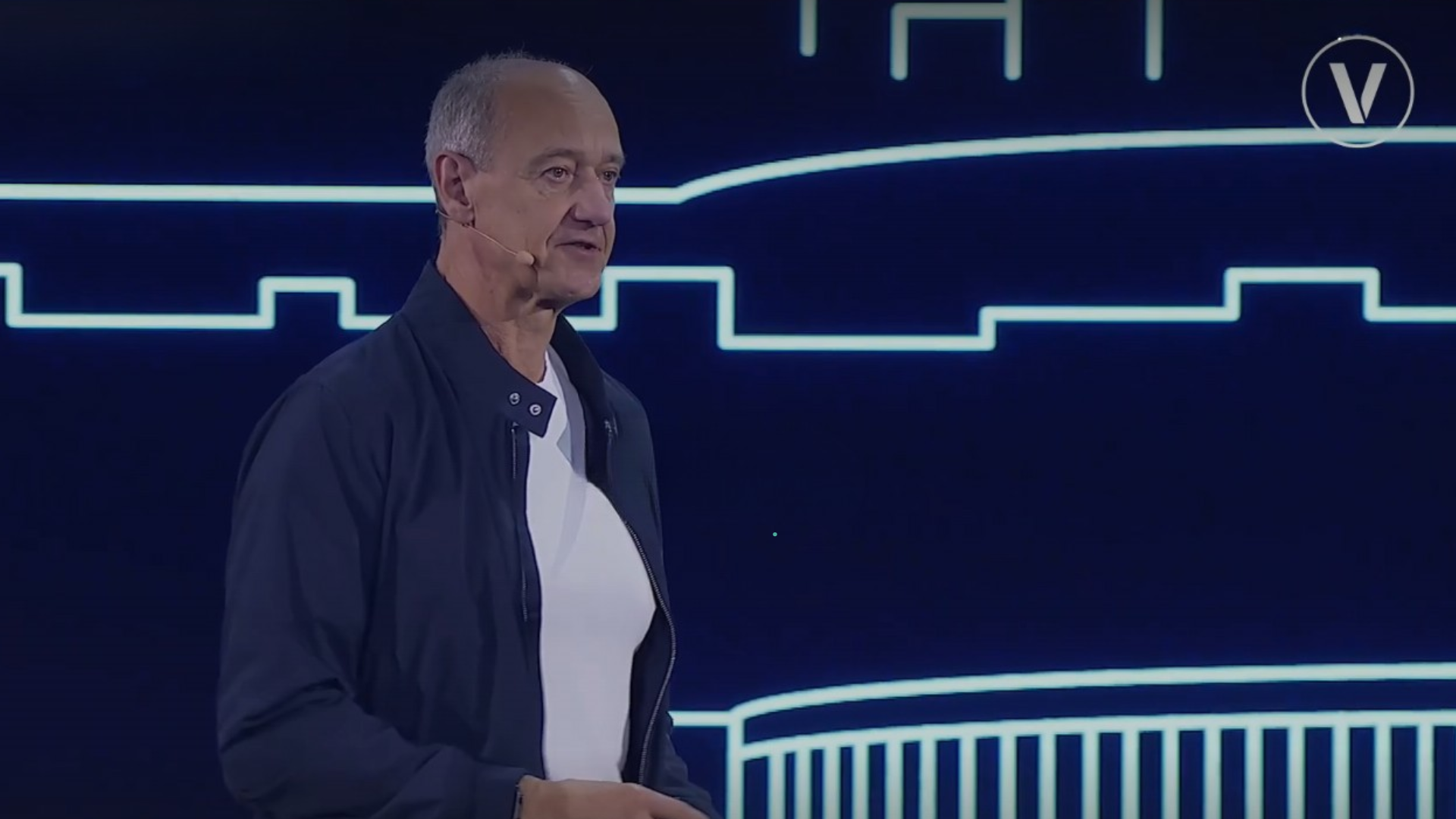
PARIS — Siemens is betting that the future of industrial artificial intelligence will be built on digital twins, autonomous engineering agents and AI-powered factories that move beyond experimentation to measurable business results, CEO Roland Busch said at the VivaTech conference in Paris.
Busch outlined how Siemens is embedding AI across the industrial lifecycle — from product design and engineering to manufacturing operations — arguing that industrial AI differs from consumer AI because it is built into real-world processes from the outset rather than added afterward.
“It is more about having embedded AI technology from the beginning,” Busch said at the tech event, which sponsored The AI Innovator‘s trip. “And that’s what sets industrial AI apart.”
A key pillar of Siemens’ strategy is the use of digital twins, virtual replicas of machines, factories and logistics networks that allow companies to test designs and operations before making costly physical investments. Busch said customers can use Siemens software to create physics-based, photorealistic simulations that model real-world behavior in real time.
He cited logistics company Toyota Material Handling, which uses Siemens’ Digital Twin Composer to simulate warehouse layouts and evaluate throughput before moving equipment. The technology allows companies to stress-test operations virtually rather than through costly trial and error in the physical world.
Siemens is also accelerating engineering simulations through its partnership with Nvidia. Busch said tasks such as aerodynamic modeling, which traditionally required days of computing time, can now run 10 to 1,000 times faster using accelerated computing. The company also announced new capabilities in its Simcenter SimSolid software that eliminate time-consuming meshing processes, reducing structural calculations from weeks to minutes.
To encourage innovation, Siemens unveiled a startup program that offers discounts of up to 95% on design, engineering and simulation software. Busch highlighted French rocket startup Latitude, which consolidated multiple tools onto Siemens software and achieved a six-month reduction in project delivery times along with a 15% increase in engineering efficiency.
The company is also expanding its use of autonomous AI agents in industrial engineering. Busch described Siemens’ recently launched Industrial Copilot Engineering Agent as more than a chatbot, saying it can independently plan tasks, gather documentation, generate executable code and repeatedly validate results until the software functions properly.
According to Busch, customers have reported 50% higher productivity, development cycles that are 2.5 times faster and 80% higher quality when using the system. Siemens announced two new capabilities at VivaTech: The agent can now automatically incorporate electrical design plans into automation projects and can build software according to company-specific engineering standards and documentation requirements. Tasks that previously required days of manual effort can now be completed in minutes, he said.
On the factory floor, Busch said Siemens is applying AI to improve quality control, automation and energy efficiency. He highlighted a welding line at a car manufacturing plant where AI systems inspect 2,000 weld points per minute using cloud-trained models running on edge infrastructure.
Busch also pointed to Siemens’ facility in Erlangen, Germany, which he described as the world’s first fully AI-driven production site. The factory currently employs about 100 AI algorithms and has achieved a 40% reduction in time to market, 42% lower energy consumption and a 69% increase in productivity, according to Siemens.
Author
Get the latest insights about enterprise AI.
Subscribe to our newsletter. Thank you.