Chinese AI models are “closing the gap” in performance with those from top U.S. frontier labs while being “materially” cheaper to run, according to a July 6 report from BofA Global Research.
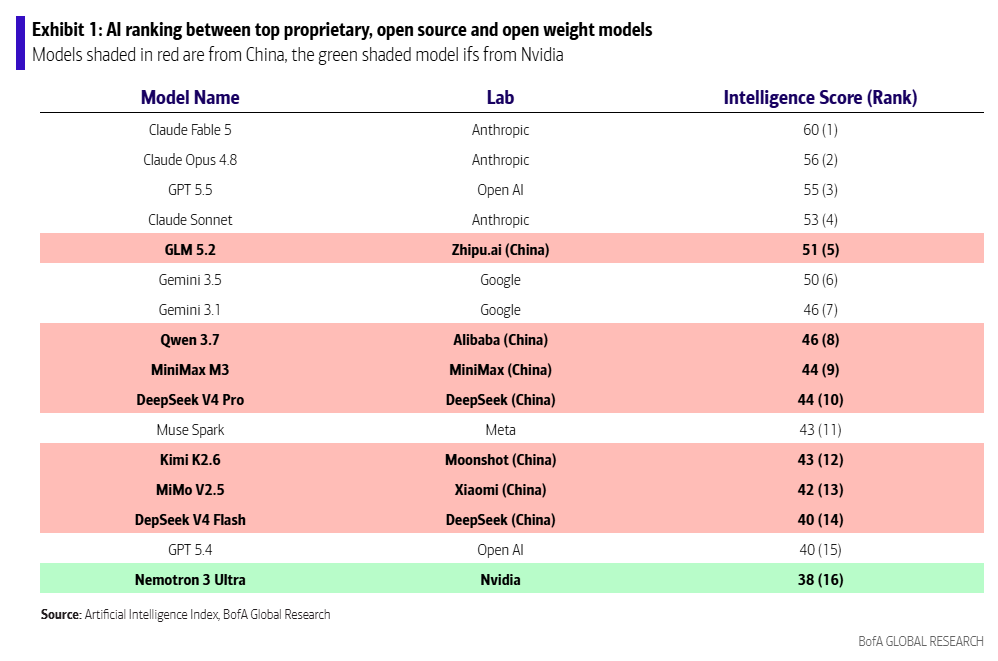
Analyst Vivek Arya wrote that Chinese open-weight models from companies including Zhipu AI (GLM), Alibaba (Qwen), DeepSeek, Moonshot AI (Kimi) and Xiaomi (MiMo) now occupy eight of the top 16 positions in the Artificial Intelligence Index, a widely followed AI ranking.
While U.S. frontier models from Anthropic and OpenAI continue to lead overall, he said Chinese developers are now only months behind rather than years behind despite U.S. export restrictions on advanced AI chips.
Open-weight models make their trained model weights publicly available so developers can download, modify and run them on their own infrastructure. Unlike fully open-source models, however, they typically do not disclose the training data, code or methodology used to build them. (The leading U.S. AI models are closed, or proprietary, models.)
Although concerns persist that Chinese AI models could be used to collect sensitive data, open-weight models can be downloaded and run entirely within an organization’s own environment, allowing enterprises to keep prompts, data and inference workloads behind their own security controls.
The emergence of Chinese models offering lower inference costs has raised concerns that the pricing could hurt U.S. competitiveness. BofA argues that the impact is bigger on AI software companies such as OpenAI and Anthropic rather than hardware.
“Lower-cost intelligence expands usage, broadens deployment and ultimately increases demand for compute, memory, networking and power infrastructure,” the analyst wrote. “The bigger risk is to model economics, not semiconductor demand.”
Outcomes matter more than benchmarks
The report said investors traditionally have focused on performance benchmark rankings among large language models. But as AI evolves from standalone chatbots to autonomous agents and enterprise workflows, Arya said, businesses will increasingly prioritize outcomes rather than which model scores highest on technical benchmarks.
Similar to how the internet commoditized information while creating enormous value for software companies, more capable open-weight models could expand the overall AI market even as competition pressures model providers, according to Arya.
The analyst is forecasting that global cloud and AI capital expenditures will increase 40% to 50% year-over-year to $1.5 trillion by 2027, supported by growing AI agent adoption, rising token usage and continued investment by hyperscale cloud providers.
Arya described the recent 11% decline in the Philadelphia Semiconductor Index following an 88% rally in the second quarter as a healthy reset rather than a reversal of the AI investment cycle.
He expects renewed strength in memory, compute, semiconductor equipment, networking and optical component makers as visibility into 2027 spending improves.
The analyst said memory now accounts for about 35% to 40% of cloud AI capital spending – up 2x to 3x from historical trends – while memory companies are trading at a “sub-par” 10x forward price to earnings ratio. Arya’s top pick is Micron, reiterating his “buy” rating.
“We believe the market is underestimating the transition toward longer-duration agreements and more predictable pricing,” Arya said.
Author

Get the latest insights about enterprise AI.
Subscribe to our newsletter. Thank you.