TLDR
- SpaceX’s record-breaking debut is the first in a wave of massive tech IPOs that could potentially reshape global capital markets.
- Investors are betting on SpaceX’s long-term AI plans, including space-based data centers, rather than its current AI revenue.
- Once added to major indexes, SpaceX could become a significant holding in millions of retirement accounts and index funds, increasing AI’s influence on investor portfolios.
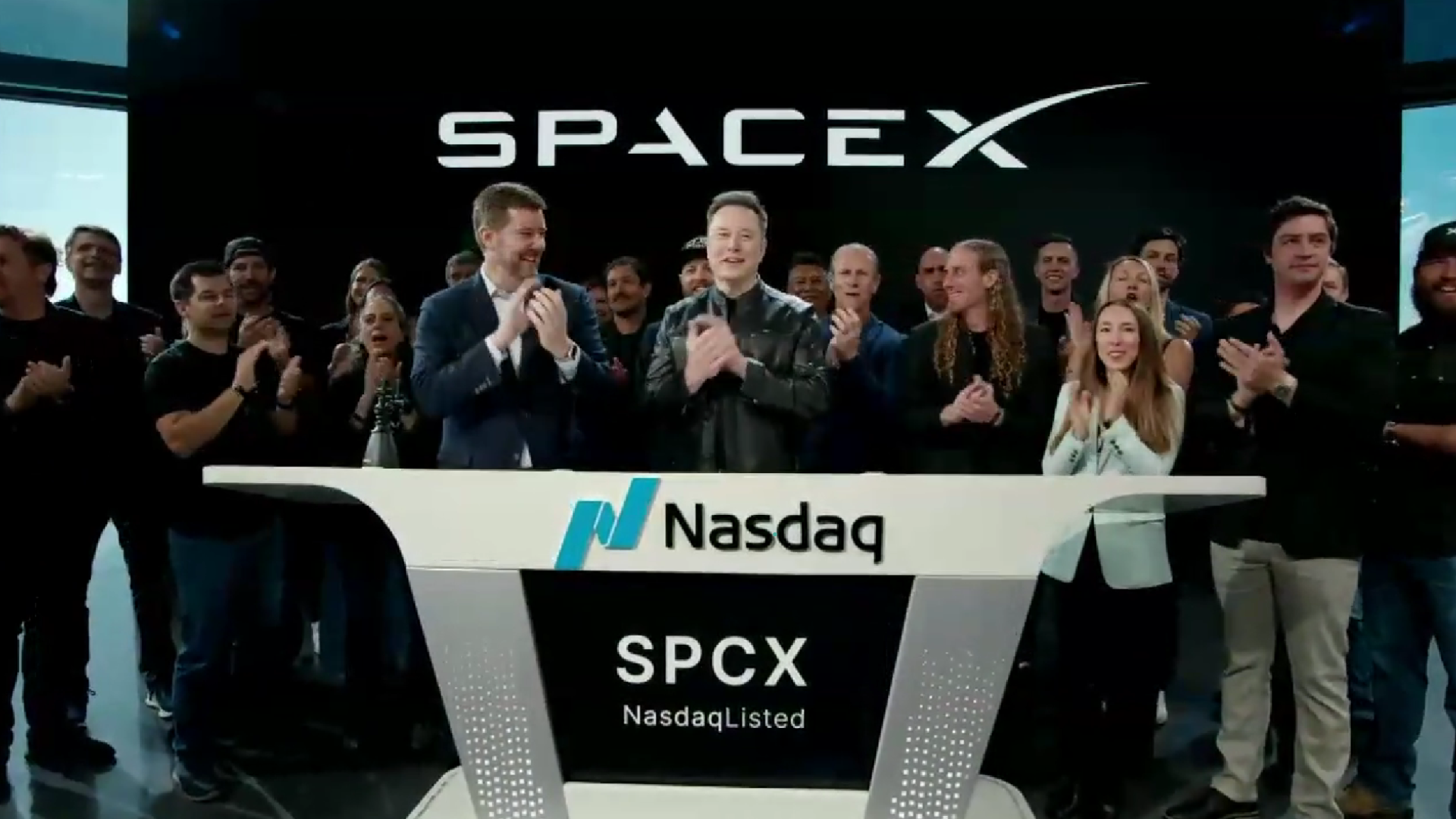
SpaceX went public today as the largest IPO in history, raising $75 billion.
The stock (SPCX) opened at $150 a share on the Nasdaq, 11% over its IPO price indicating higher-than-expected demand. In afternoon trading, the stock rocketed past the IPO price by around 28% to $172.75 a share and valuing SpaceX at $2.2 trillion.
Founder and CEO Elon Musk is officially the world’s first trillionaire, combining all his holdings.
“It is certainly hard to believe that a little company that started in a warehouse in El Segundo, (Calif.) is now going public for the largest IPO ever,” Musk said at SpaceX offices in Starbase, Tex. “I gave SpaceX less than a 10% chance of succeeding at all. To be clear, in fact, I told people this. I said, probably going to fail, but should give it a try, because if we don’t, if there’s not a new company that enters space, we will never be a truly space-faring civilization.”
“While the other aerospace companies, they build good rockets and everything, they were simply not pursuing the technology that was necessary to make life multi-planetary, to make Star Trek, to make the exciting science fiction futures that we’ve read about real, and that’s what SpaceX is all about, is to take the fiction out of science fiction and create an exciting, inspiring future for everyone.”
“There are always problems on earth, there are always things that we wish to be better, that we want to solve here on earth, and we should solve them,” he said. “But there also have to be things that get you excited about the future, that make you glad to wake up in the morning, because you can’t wait to see what happens next, and that’s the future that SpaceX wants to bring to you.”
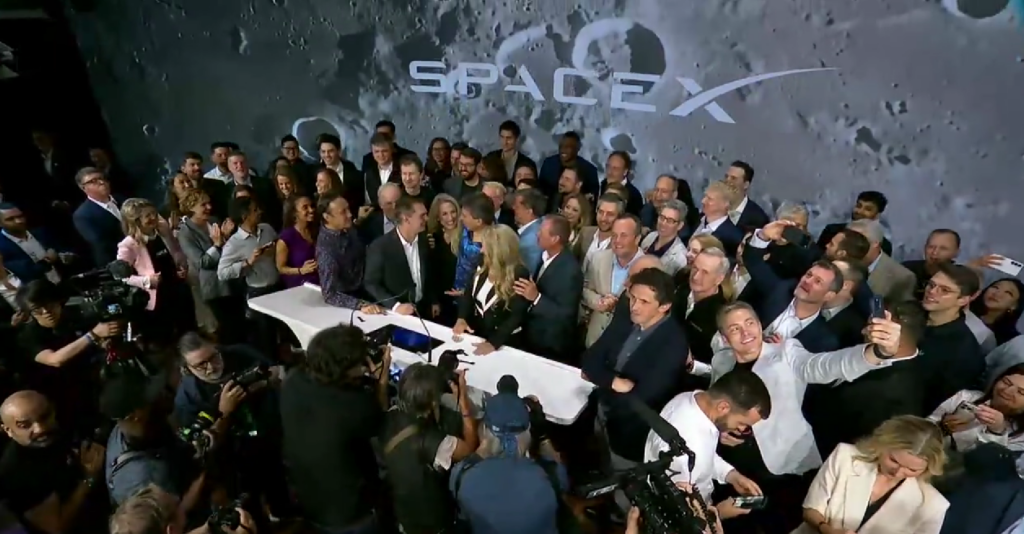
Days ahead of the IPO, Reuters reported that investor demand had topped $250 billion, nearly four times oversubscribed.
The debut comes at a time when investors are closely watching a potential wave of upcoming blockbuster technology IPOs that include OpenAI and Anthropic. The trio could potentially reshape capital markets, redraw investment flows and accelerate the growing influence of artificial intelligence and emerging technologies on major stock indices.
“Simultaneous IPOs from SpaceX, OpenAI and Anthropic would likely represent one of the largest capital market events in decades,” Daniela Hathorn, senior market analyst at Capital.com, told The AI Innovator. “Collectively, these companies could command trillions of dollars in market value, creating a powerful gravitational pull on global capital.”
She said investors would likely take money out of existing holdings to gain exposure, potentially creating short-term volatility elsewhere in the market.
“As a result, the impact on valuations could be significant,” she continued. “On one hand, successful listings would provide a benchmark for private-market AI valuations and potentially validate the enormous sums currently being invested in artificial intelligence.”
“On the other hand, they could absorb a substantial amount of investor capital, particularly from institutions that currently hold large positions in existing AI beneficiaries such as Nvidia, Microsoft, Alphabet and other semiconductor names. In that sense, the IPOs could initially broaden the AI trade while simultaneously creating new competition for capital within the sector,” Hathorn said.
Betting on future success
SpaceX’s valuation itself is generating debate.
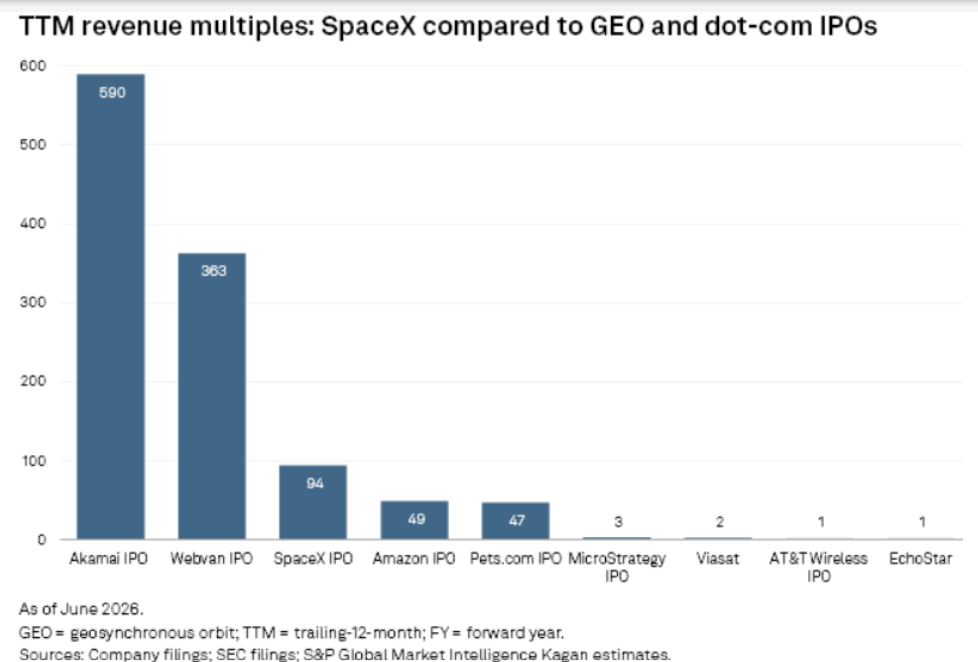
According to S&P Global Market Intelligence, a $135 share price and 13 billion shares outstanding translate to a market capitalization of $1.76 trillion – or about 94 times trailing 12-month revenue.
The report found that only 17% of SpaceX revenue currently comes from its AI business – including xAI – down from 29% in 2023. Revenue growth in the AI segment has averaged a “slow” 4% compound annual growth rate (CAGR) since 2023, compared with 7% growth in its Space division and 72% growth in its Connectivity segment, which includes its Starlink satellite broadband business.

The findings suggest that investors may be placing greater value on SpaceX’s future AI ambitions than on its current AI financial performance.
Recent investor presentations have highlighted plans to expand into orbital AI computing infrastructure, a business the company views as a major long-term growth opportunity. Reuters reported that SpaceX is pursuing space-based AI data centers and plans demonstration missions as early as 2027. The initiative is closely tied to Starlink and the development of the company’s Starship rocket system.
Impact on investor portfolios
For passive investors, the effects of the IPO could extend far beyond those who actively buy shares.
Once SpaceX is included in major indices such as the S&P 500 and Nasdaq-100, index funds, exchange-traded funds, pension funds and retirement accounts would likely be required to purchase the stock in proportion to its weighting.
“Given the likely size of these companies, passive funds could become major buyers almost immediately,” Hathorn said. “This would increase exposure to AI and emerging technologies across millions of retirement accounts, often without investors making an active decision to own the stocks.”
The development could further increase market concentration, a trend that has accelerated in recent years as a small group of technology companies generated an outsized share of stock market gains.
“We have already seen this dynamic with the Magnificent Seven, where a handful of companies have driven a disproportionate share of index returns,” Hathorn said, referring to Alphabet, Amazon, Apple, Meta, Microsoft, Nvidia and Tesla.
“Adding several trillion-dollar AI-related businesses could amplify that trend further. The opportunity is obvious: exposure to some of the most innovative companies in the world. The risk is that broad-market indices become less diversified than many investors assume,” she said.
“… what SpaceX is all about, is to take the fiction out of science fiction and create an exciting, inspiring future for everyone.” — Elon Musk
For active fund managers, the arrival of new mega-cap technology stocks presents both opportunity and risk.
“The emergence of three new mega-cap companies would create both opportunities and challenges,” Hathorn said. “Active managers would have the ability to overweight or underweight these businesses based on their assessment of valuations, competitive dynamics and future earnings potential.”
At the same time, she noted that outperforming benchmark indices could become more difficult if newly public AI companies continue to outperform and grow into larger portions of those indices. “The result could be an environment where stock selection matters more than it has for years, particularly if dispersion between winners and losers within the AI ecosystem continues to widen,” Hathorn said.
“The broader takeaway is that such IPOs would likely accelerate trends already underway in capital markets: greater concentration, increased importance of AI-related earnings growth, and a stronger connection between technological innovation and index performance,” she added.
“For investors, the key question would not simply be whether these companies are successful, but whether the future growth implied by their valuations ultimately justifies the amount of capital that markets are likely to allocate to them.”
Author

Get the latest insights about enterprise AI.
Subscribe to our newsletter. Thank you.