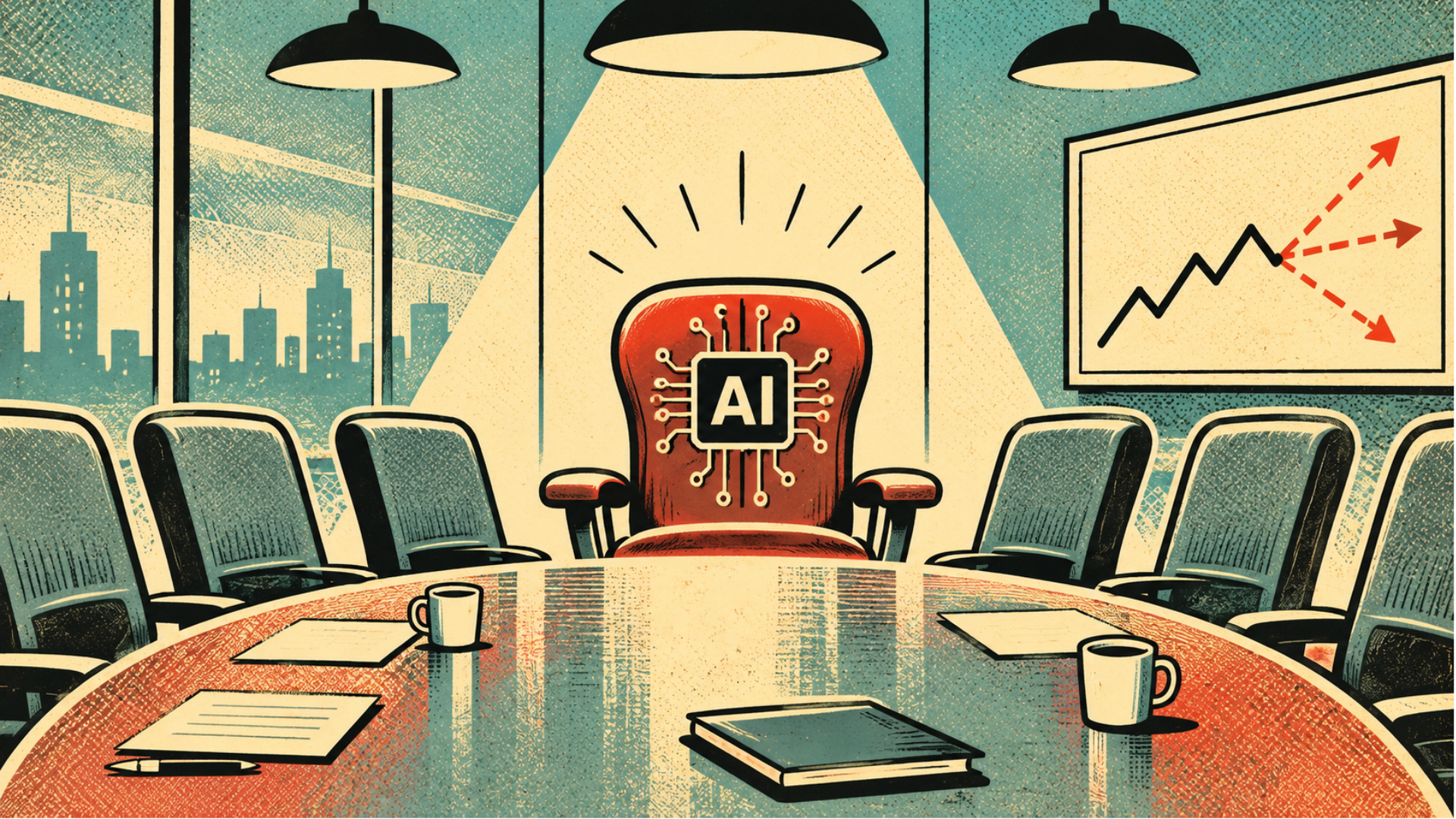
In April, corporate directors attending an AI board forum were discussing the need to become literate in AI. Three months later, at the same conference held on a different coast, the conversation had changed dramatically.
Simply understanding AI was no longer enough. Directors were now expected to become fluent in the technology.
“The conversation in this space has shifted so drastically,” said Amy Rojik, national managing principal of corporate governance and founder of the BDO Center for Corporate Governance, who was in attendance.
The change reflected a growing recognition among corporate boards that AI was moving too quickly and becoming too consequential for directors to remain passive observers. It cannot just be relegated to IT.
“The scale and the breadth of exposure and opportunity in AI is a bit overwhelming and it’s making boards and management teams rethink the whole way they’re approaching risk and opportunity,” she told The AI Innovator.
Boards are recognizing the high stakes as AI transforms how companies operate, invest, manage risk and make decisions. Directors must oversee those decisions even as the technology evolves faster than traditional corporate governance processes.
The urgency is reflected in BDO’s 2026 Board Survey, which polled more than 200 public company directors in June.
AI was top of mind: 51% of directors said keeping pace with AI and emerging technologies is one of their boards’ most significant challenges over the next 12 months. Separately, asked which factor outside their organization’s control is their “greatest concern” over the next six to 12 months, 57% said the pace of AI and cybersecurity capabilities.
Yet only 36% of directors “strongly agree” that their boards have the skills and expertise to oversee AI, cybersecurity and data governance.
Rojik said the challenge is no longer simply understanding what AI can do. Directors must determine how the technology changes their responsibilities and whether their existing oversight practices remain adequate.
“It’s really about what questions as a board do I need to be thinking about now?” she said. “Can I ask the same questions that I’ve been asking? Do they still apply? Should I be asking different questions? Should I be talking to different people?”
Mistake No. 1: Letting AI do the thinking
One of the emerging risks is that directors may be starting to depend too much on AI.
BDO’s survey found that 28% of directors incorporate generative AI into independent board preparation, while 22% are incorporating agentic AI to help guide board decision-making.
Rojik supports using AI to analyze information, challenge assumptions and consider alternative perspectives. But she warned against using the technology as a substitute for human judgment.
Some directors may use AI appropriately to test their thinking. Others could be tempted to use it as a shortcut instead of thoroughly reviewing board materials.
Rojik said AI systems can provide useful information, but their outputs may contain errors or rely on incomplete data.
“We’re not at a place where AI can replace our own independent judgment,” she said. “We’ve seen too many things go wrong.”
Mistake No. 2: Delegating responsibility to an AI expert
Another mistake is assuming that hiring an AI specialist resolves the board’s oversight problem.
“Oh, we need an AI expert on our board,” she said. “Then that person becomes the de facto decision-maker for everything AI.”
The problem arises when the remaining directors begin deferring to that individual instead of developing their own understanding of the technology.
An AI expert may understand machine learning or emerging technologies but lack experience in areas such as corporate strategy or the industry where the company operates, she said. Those other perspectives are essential when evaluating whether an AI investment makes business sense.
“The full board needs to be fluent in this,” Rojik said. “The full board needs to understand what’s happening so that collectively they can arrive at a good decision for the business.”
The same principle applies to management. Appointing a chief AI officer or assigning responsibility to a technology executive does not eliminate the board’s obligation to oversee how AI affects the entire enterprise.
“It’s not an IT issue,” Rojik said. “This is fundamentally potentially changing how your business can operate.”
Mistake No. 3: Expecting AI investments to work magic
A third mistake is assuming that purchasing an AI tool will automatically produce financial returns.
Rojik said some companies invest in AI without adequately considering how the technology will change their operations or how much it will cost as usage increases.
“Just because they buy a tool or they invest in a tool, they suddenly think that’s going to create all this value,” she said.
“Then they realize, ‘well, maybe we didn’t think this all the way through’,” Rojik added. “’Maybe we didn’t understand how much this was going to cost as people start ramping up usage – and the people who sold us this tool are getting quite smart about licensing and the cost in their own right.”
Rojik said directors should examine how proposed investments will improve business performance, whether through higher revenue, greater operational efficiency or both.
Boards also need to determine where their investments will create sustainable value while avoiding unnecessary increases in their risk exposure, she added.
Ask management tougher questions
For Rojik, effective AI governance ultimately depends on the questions directors ask management and the evidence they demand in response.
Boards do not need to manage individual AI applications or become involved in every technical decision. Those responsibilities generally belong to executives.
But directors must understand where AI is being deployed, what risks it introduces and whether management has established effective controls.
That includes evaluating the companies supplying AI technology.
Rojik warned that some emerging AI vendors may offer attractive products without having mature governance practices of their own.
Boards should therefore question management about how vendors are evaluated and what safeguards protect corporate information.
“How do we vet an AI vendor?” she asked. “There are a lot of folks coming up out of the woodwork. They have a great idea, they have a great product but they may not be the most mature in their own governance.”
Rojik said boards should ask management to demonstrate that safeguards are functioning, identify areas where controls are missing and explain how remaining risks will be handled.
“Show me the evidence that you’re monitoring this, that you have guardrails on this, and show me where we don’t,” she said.
The future: An agentic board?
As AI systems become increasingly autonomous, could they eventually replace human directors altogether?
Not according to Rojik.
Her skepticism centers on the limitations of AI systems and the continuing importance of human judgment.
Corporate decisions rarely depend on perfect information. Directors must evaluate incomplete data, question assumptions, consider competing interests and exercise judgment about uncertain outcomes.
AI agents, by contrast, depend on the information and instructions available to them. Their autonomy also raises questions about whether they can reliably remain within established boundaries.
“I don’t think you can give up the autonomy to an agent that is just looking at numbers and data,” Rojik said. “There’s no perfect data. … You still need reasoning and questioning to understand.”
For now, she sees AI as a tool to strengthen directors’ thinking rather than replace them.
“It’s the board’s duty to be using tools to help them think through issues,” Rojik said.
Author

Get the latest insights about enterprise AI.
Subscribe to our newsletter. Thank you.





Be First to Comment