
TLDR
- AWS customers have reported cutting AI coding costs by 60% to 80% through smarter model selection, caching and prompt optimization.
- Visibility is important. But individual developer token-usage leaderboards can lead to adverse effects. Measure consumption at the team level instead.
- Companies should measure AI spending against developer productivity and software quality, not just token consumption.
Companies struggling to control the rising cost of AI coding tools could reduce their token spending by as much as 80% while maintaining software quality, according to a senior principal technologist at AWS who advises businesses on developer productivity.
Laura Tacho, who was also the former CTO of software firm DX, said companies are moving away from encouraging developers to consume as much AI as possible toward a more disciplined approach that measures the business value produced by those tools.
In an interview with The AI Innovator, Tacho said AWS customers have reduced token spending by 60% to 80% by combining several cost-control techniques, including routing tasks to less expensive AI models, reusing previously processed information and making developers more aware of their consumption.
“Last year, organizations were talking a lot about driving adoption at all costs,” Tacho said. “The problem has shifted from getting everyone to use AI to using AI most efficiently.”
The shift comes as companies discover that widespread adoption of AI coding assistants doesn’t necessarily translate into similar gains in software development productivity. AI can generate code faster, but organizations still need to review, test and deploy it through systems originally designed for human developers working at a slower pace.
Tacho said many companies are experiencing a period in which spending and adoption have increased faster than measurable business results, she said.
The challenge for technology executives is no longer simply getting developers to use AI. It is determining which tasks justify the expense, how much companies should spend and whether the resulting software is worth the investment.
Match the AI model to the task
One of the most effective ways to reduce token consumption is to stop using expensive frontier AI models for every coding assignment, Tacho said.
Instead, companies can deploy intelligent model-routing systems that evaluate the complexity of a developer’s request and direct it to the least expensive model capable of meeting the necessary quality standards.
Under this approach, sophisticated models are reserved for difficult assignments, while less expensive or open-weight models handle simpler tasks.
“Putting in those routing layers can drive significant cost savings,” she said.
Intelligent routing typically works through a centralized system that receives a request, evaluates the likely performance of available models and selects one based on expected accuracy and cost.
For example, rather than automatically sending a routine coding request to a premium model, the routing system can determine whether a cheaper alternative is likely to produce an acceptable result.
Another option is to fall back to using regular automation. “The best way to save money on inference is to not use AI when you don’t need to use it,” Tacho said.
Notably, cheaper isn’t necessarily better if the resulting code requires more corrections or introduces defects.
Tacho said companies need automated evaluations to determine whether lower-cost models consistently meet quality requirements. Quality metrics include how much work developers must redo, the number of review comments and the time required to complete software changes.
The problem is that many organizations lack the data infrastructure and measurement practices needed to make those assessments, she said.
Eliminate repeated token processing
Another technique involves caching, which allows AI systems to reuse information previously processed instead of repeatedly charging for the same context.
AI coding assistants often receive extensive background information, including instructions and details about a software project, with each request. Much of that information may remain unchanged across successive interactions.
Caching can reduce the need to process identical material repeatedly. AWS and other cloud providers typically offer lower pricing for cached tokens than for newly processed input.
Tacho said companies should examine their prompting and caching practices to identify unnecessary duplication.
Companies can also control costs through batch inference, grouping AI processing jobs that don’t require immediate responses and running them more efficiently during off-peak periods.
Tacho cautioned that optimization cannot be treated as a one-time exercise. Models, pricing structures and development tools are changing rapidly, requiring companies to review their choices regularly.
“This isn’t an optimize and forget it kind of routine,” she said.
Ditch the leaderboards
Technology executives also need to change how they manage developers using AI, Tacho said.
Some organizations ranked developers according to how many tokens they used to encourage token consumption. These leaderboards created competition among employees, but such incentives can be counterproductive.
Developers rewarded for consuming more tokens may use expensive tools unnecessarily. But rewarding developers for consuming fewer tokens can create the opposite problem: Employees may avoid using AI even when it would produce better results.
She recommends measuring usage at a team level and “avoiding a leaderboard altogether.”
“The tricky part with exposing this at an individual level is that then we leave the door open for adverse behavior or adverse effects,” Tacho said. “So like any developer productivity metric, measuring at the team level or higher is the recommended way to get the result.”
Companies should track spending by project, task and stage of the software development process. One useful measurement is the cost per software change, which includes tokens consumed to write, review and deploy code.
This gives managers a clearer picture of what their organization is spending to deliver a particular result.
Tacho cited a company she worked with that discovered its AI-powered code review process was costing approximately $20 per pull request, or a proposed change to a software codebase. “That was actually a lot more than what they were spending on other infrastructure and tooling,” she said.
That prompted a broader examination of whether every proposed change required an AI review. “The visibility allowed them to design a system that used tokens most efficiently and targeted them at the problems that really needed or would benefit most from agentic review,” she said.
Set budgets, not hard limits
Tacho said companies should establish AI spending budgets for development teams, with automated alerts that notify managers when usage approaches certain predetermined levels.
Some companies send warnings when teams reach 70%, 80% or 90% of their allotted budgets. Rather than automatically shutting off access, managers can then review whether additional spending is justified by the work being performed.
The approach gives companies financial oversight without discouraging developers from using tools that may be essential to their work.
Tacho said technology executives generally budget for AI coding tools based on monthly or annual spending per developer, rather than allocating a fixed percentage of the overall IT budget.
The appropriate amount varies considerably among organizations.
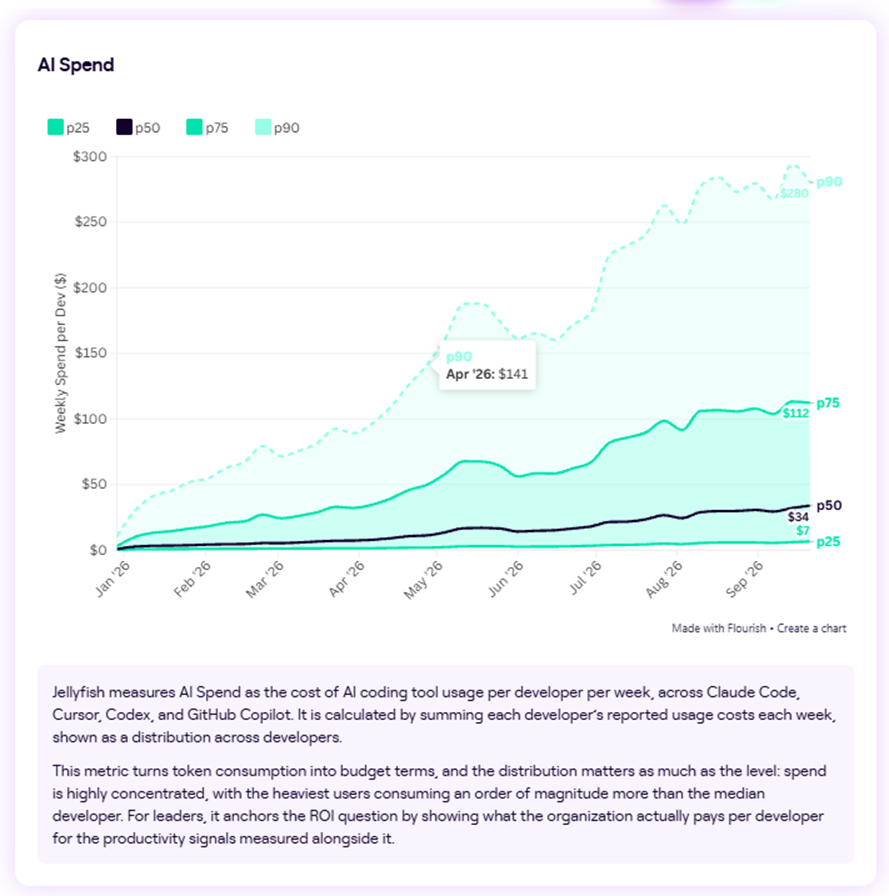
Data from software intelligence company Jellyfish show that weekly AI spending per developer rose sharply between January and September 2026. By September, developers at the 90th percentile were spending about $280 a week, compared with $34 at the median, according to the company’s research. That translates to $1,120 for top spenders and $136 per developer at the median, in one month.
Tacho said she had also heard anecdotal reports of companies spending $2,000 to $3,000 per developer each month.
Managing those costs could become more difficult as use of AI coding tools spread beyond IT engineers to employees in other departments. Meanwhile, AI is also expanding into other stages of software development.
“We’re seeing AI get into product discovery, into code review, into SRE (site reliability engineering) activities,” Tacho said. “It’s a very, very big surface area that AI still has to cover.”
Rigid spending limits can create security problems. Tacho said some developers who use up their company AI budgets switch to using their personal AI accounts and other tools. The concern is that developers may send proprietary code or other company information through AI services that lack enterprise security controls and monitoring.
“It absolutely happens, and it is a very big risk for organizations,” she said.
Author

Get the latest insights about enterprise AI.
Subscribe to our newsletter. Thank you.











Be First to Comment