
TLDR
- AI is changing M&A not only by making research faster but more importantly enabling deeper analysis, helping buyers examine more data, test assumptions and make decisions with greater confidence.
- AI adoption is widespread but uneven: 90% of surveyed M&A leaders use AI to some degree, yet use is much higher in target screening and diligence than in judgment-heavy areas such as negotiation.
- Humans remain in charge of consequential deal decisions because AI errors can carry major financial consequences, while negotiations and integration still depend heavily on judgment, expertise and relationships.
Dealmaking has historically been an intensely human activity. Long before there were investment banks, electronic data rooms or spreadsheets, people negotiated exchanges of property, businesses and other assets based on information, judgment, trust and their assessment of the person sitting across the table from them.
Technology has gradually automated pieces of that process. Databases made companies easier to find. Spreadsheets transformed financial analysis. Electronic data rooms replaced rooms filled with paper. Software made it possible for teams scattered around the world to work on the same transaction.
Artificial intelligence is taking that transition considerably further.
AI can now help companies identify acquisition targets, sift through thousands of documents, reconcile messy datasets, analyze contracts, test integration scenarios and flag problems that deal teams might otherwise struggle to find within the limited timetable of a transaction.
But the closer the process gets to its most consequential decisions – whether to buy a company, how hard to negotiate and how two organizations should actually be put together – the more stubbornly human M&A remains.
That divide is emerging as one of the defining features of AI’s adoption in dealmaking, Adam Reilly, national managing partner for M&A services at Deloitte, said in an interview with The AI Innovator.
“Everybody started talking about how it was going to make everything faster – and we could do things faster,” he said. “But it’s the least interesting part about AI in M&A. It’s really about the depth of analysis and the ability to get to better decisions and have more certainty around your plans.”
In turn, that level of confidence could lead to a higher purchase price. “AI has the opportunity to increase the price that buyers are willing to pay because of that increased level of conviction,” Reilly added.
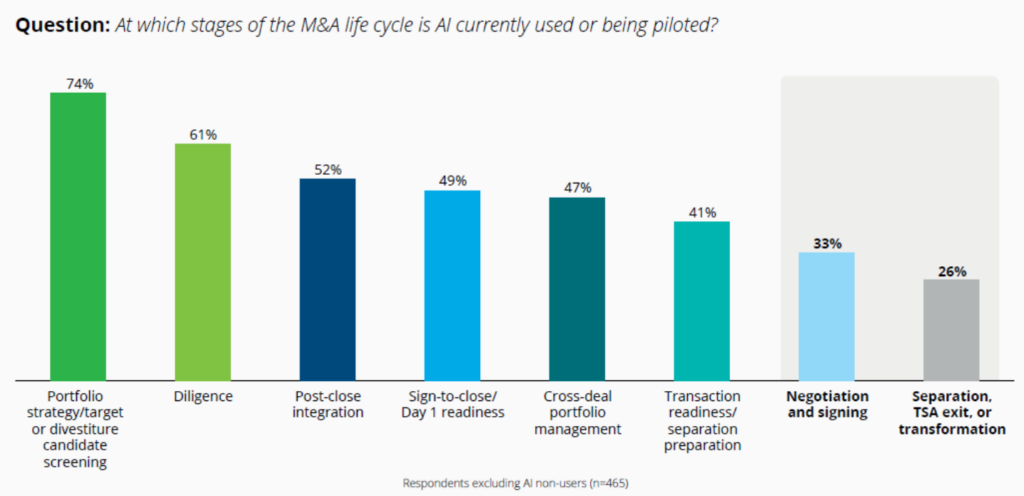
The use of AI in M&A is pervasive. Deloitte’s 2026 GenAI in M&A Pulse Survey found that 90% of U.S.-based private equity, portfolio company and corporate M&A leaders surveyed were using AI in M&A to some degree.
Yet adoption varies sharply depending on the work being performed: 74% are using it for portfolio strategy and target or divestiture screening, and 61% for diligence. Half were using AI in post-close integration and 49% for sign-to-close or Day 1 readiness. Only 33% use it in negotiation and signing.
Where AI fits in the M&A workflow
The M&A process typically begins before a buyer has selected a company.
Executives first make a strategic decision about whether to build a capability internally, buy it or partner with another company. Once they decide to buy, they need to figure out what to buy.
In this target-screening stage, AI is used to search and synthesize enormous amounts of information, according to Reilly.
Deal teams can query public and commercial databases for companies operating in a particular market and narrow them using parameters such as employee count, revenue or other characteristics. AI can help turn that information into a universe of potential acquisition targets much faster than traditional research methods.
But the machine-generated list is a starting point.
People who know an industry can look at the candidates and quickly conclude that one company makes no strategic sense, another belongs on the short list and a third deserves more research. At this stage, teams generally work with external data sets such as SEC filings rather than confidential information supplied by a potential target.
Eventually, the buyer narrows the field, approaches potential targets and, if there is mutual interest, gains access to management and proprietary company information.
Reilly said AI can help standardize inconsistent data, reconcile information from different sources and extract useful information from datasets that historically would have required substantial manual cleanup.
“You can use AI to get better information out of worse data,” he said. “In the old world, bad data was very hard to use because if you had to manually go through it and comb it, even things like standardizing names in a customer database might be incredibly time-consuming. AI is pretty good at doing a lot of that type of work.”
AI also expands how much material a team can realistically examine. Instead of reviewing a sample set of contracts, for example, Reilly said a buyer can analyze many more of them, potentially producing a richer picture of customer relationships and revenue patterns.
The time saved by AI can be reinvested in asking harder questions, allowing buyers to perform more analysis before making a decision, Reilly said. The potential result is not merely faster diligence but greater conviction in the assumptions behind the decision to acquire a target company.
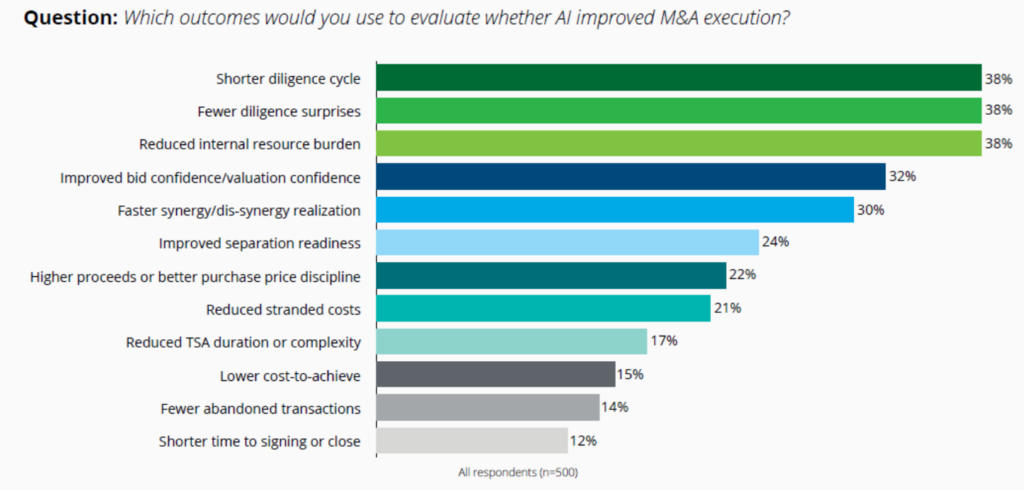
That distinction is showing up in Deloitte’s survey. When respondents were asked how they would evaluate whether AI improved M&A execution, 38% selected a shorter diligence cycle. But the same percentage selected fewer diligence surprises, while 32% selected improved bid or valuation confidence and 22% cited higher proceeds or better purchase-price discipline.
Reilly noted that AI’s value proposition in M&A is increasingly about the quality of the decision, not simply the speed at which it is made.
Can AI produce a better deal?
That does not mean AI automatically makes acquisitions more valuable.
Reilly said it is unclear yet whether AI-assisted acquisitions influence the value of the deals themselves. What’s clear is that AI can make the analysis behind a price more precise.
“When we look at like what drives value in deals, a lot of it is about the ability for the buyer to have the best level of conviction in their thesis about doing the deal,” he said.
AI could therefore uncover information that makes a buyer more confident in its valuation. Just as importantly, it could expose risks that cause the buyer to reduce its offer, demand different terms or walk away.
Once a transaction is signed, AI’s limits become more apparent.
Integration is one of the most people-intensive stages of M&A, Reilly said. Executives have to decide how two companies will operate together, which systems and processes to retain, how organizations should be structured and what needs to happen first.
AI can help with those decisions without making them. Reilly gave the example of combining two finance organizations. Rather than simply using AI to create the same integration plan faster, a team could examine multiple organizational scenarios before choosing the best plan.
“We’re starting to see where AI can be useful when paired with deep expertise,” he said. Deloitte’s survey showed that 35% of senior leaders said combining AI with advisory expertise yields the most value while 20% cited a fully managed solution combining tech and execution support.
Another area of limitation for AI is in negotiations.
Only one-third of respondents surveyed reported using it in negotiation and signing, considerably below its use in target screening or diligence. In its report, Deloitte describes these as “judgment-intensive negotiating steps.”
That gap matters because a negotiation isn’t simply an information-processing exercise. Reilly pointed to personalities and dynamics between leadership teams – including whether the people at the two organizations can work well together – as factors that remain difficult for AI to quantify.
When 95% accuracy isn’t enough
There is another reason humans remain in the loop: AI can be wrong.
In many applications, a mostly correct answer may be useful. In M&A, a small error can alter a valuation or cause a buyer to misunderstand a material risk.
“If it’s a 95% (correct) answer, that might be actually worth less than no answer at all to our client because if you’re wrong it can have huge implications,” Reilly said.
“Sometimes that can still be very valuable, but you have to really understand the context of the information to know whether a partial answer may be helpful or actually unhelpful to a deal getting done.”
That means the emerging M&A workflow is not simply AI replacing analysts.
AI-generated analysis still needs controls. Reilly said systems can be designed to provide reconciliations showing how data ties together, expose assumptions and identify places where information did not match. In some cases, multiple agentic workflows can be run against the same data as a form of cross-checking. Human experts then evaluate the output rather than blindly accepting an AI-generated conclusion.
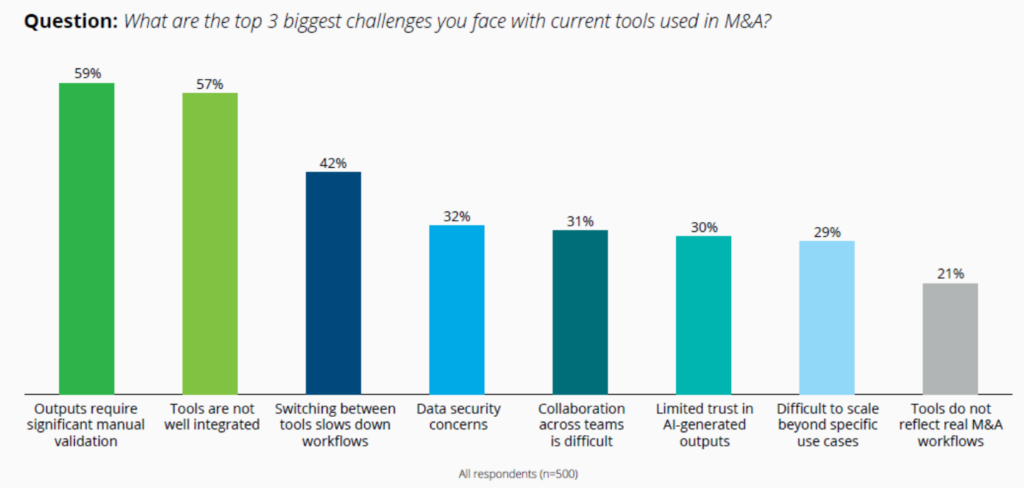
In Deloitte’s survey, 67% cited unclear accountability for AI-generated content or inaccurate or inconsistent outputs.
Another issue in using AI for M&A is privacy and security concerns. Some of the information most valuable to a buyer is precisely the information a seller most needs to protect.
Data uncovered in diligence activities include customer information, contracts, financial records and proprietary operating data. Feeding that data indiscriminately into an external AI model would risk the information being used for training and potentially exposed to the public.
Reilly said companies are looking for ring-fenced environments in which transaction data remains confined to the intended use case and isn’t retained by or used to train an underlying model.
Deloitte’s survey noted that 70% of respondents cited security or compliance concerns as a risk or limitation in using generative AI for deal governance.
While the issue of “data security and privacy is clearly nothing new for M&A transactions,” Reilly noted, AI changes the context in which companies have to determine where their information goes and how it is used.
As AI increasingly drives M&A processes, it also raises a provocative future possibility: Could the agents eventually negotiate directly with one another?
“I think we’re a long way from that,” Reilly said. “There’s a human element in dealmaking that isn’t (going away). … AI is going to massively have a huge impact on how we do things. But at the end of the day, I still think we’re human-led as far as actually driving decision-making and ensuring people get on board with those decisions.”
Author

Get the latest insights about enterprise AI.
Subscribe to our newsletter. Thank you.