
TLDR
- Bank customers are embracing gen AI for research, but they don’t trust it to act on their behalf.
- Customers trust bank websites more than search engines, gen AI tools or social media for banking product information.
- Banks should offer transparency, opt-in capabilities and explicit customer approval before letting AI take consequential actions.
Bank customers are increasingly turning to generative AI to research financial products, according to new Deloitte research, but most aren’t ready to let the technology make financial decisions or transactions for them.
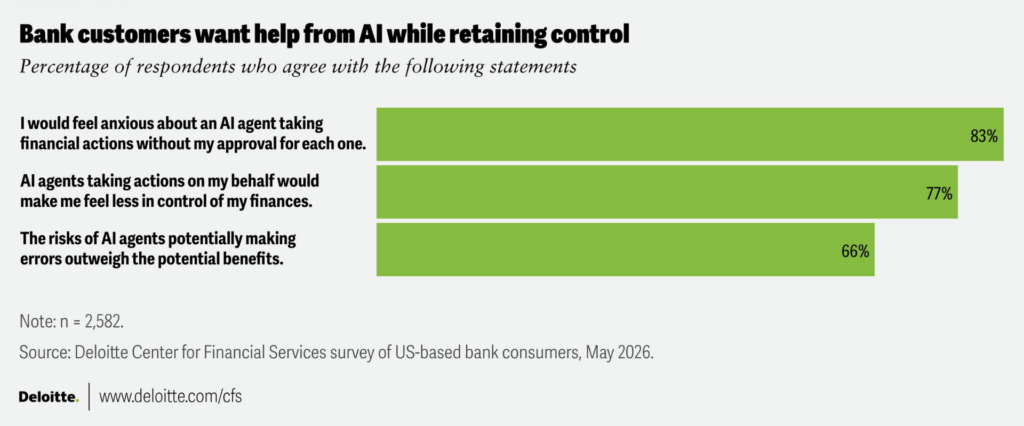
That divide between using AI for information and trusting it to act is emerging as an important boundary for banks developing AI-powered customer experiences.
In a Deloitte survey of nearly 2,600 U.S. banking customers, 83% said they would feel anxious about an AI agent taking action on their finances without their approval, while 66% said the possibility that an agent could make errors outweighs its potential benefits. At the same time, among respondents who use generative AI, 58% have used it to research banking products.
“What surprised me was the relatively high, increasing levels of usage of gen AI tools and LLMs, despite these trust concerns that banking customers have in the content and recommendations,” said Baylee Simon, a principal at Deloitte and one of the report’s authors, in an interview with The AI Innovator.
“What that shows you is that the convenience factor outweighs some of the trust (issues) in the research and investigation phase,” she continued. “But once you get to the tipping point of actually taking an action, that is where the trust in a bank versus an LLM tool or an agent starts to take over.”
The findings point to what Simon described as a tipping point in customers’ acceptance of AI. Consumers appear willing to trade some confidence in the technology for the convenience it offers when gathering and synthesizing information. But that calculation changes when the technology moves from advising to acting.
“It is a bridge too far for them – yet – to have an AI tool or an agent actually make a decision on their behalf,” Simon said.
Banks retain a trust advantage
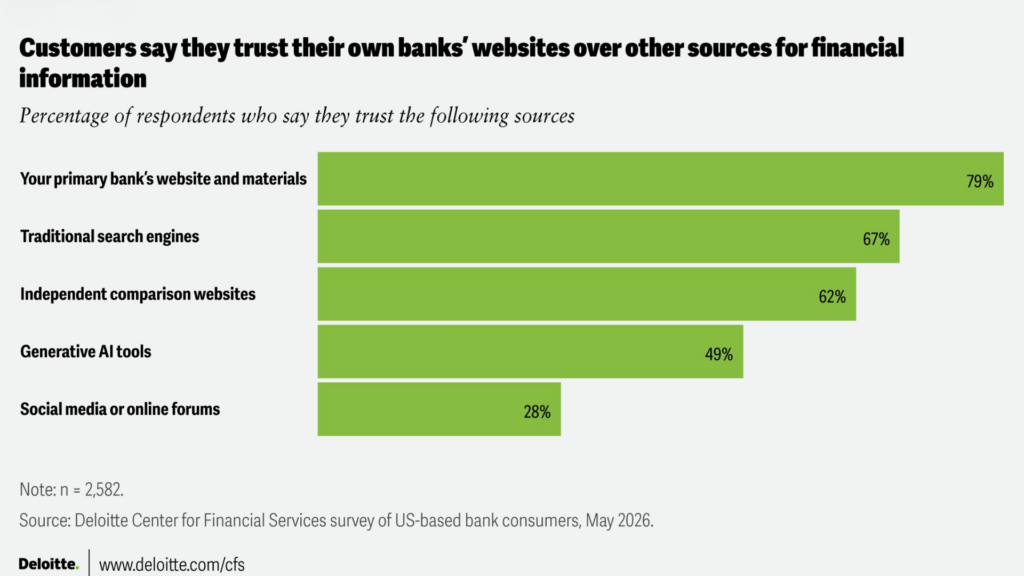
For now, banks have a substantial advantage over AI tools when it comes to trust. Eight out of 10 of survey respondents said they trust information from their bank’s website when researching banking products, compared with 67% for traditional search engines, 49% for generative AI tools and 28% for social media. Only 46% said they trust the accuracy of banking recommendations generated by AI tools.
But consumers also see practical benefits in AI. More than half of those surveyed said generative AI is more useful than search engines, while more than 40% said it provides more useful information than bank websites or apps.
That creates both an opportunity and a potential threat for banks. Simon said institutions should use their existing trust advantage now because it could diminish as AI tools become more familiar, personalized and embedded in consumer behavior.
“The key message to banks, given the trust and equity that they have built up over the years and the advantage that banks currently have, … is act now,” she said. “You want to take action now to stay relevant and build upon that trust.”
Banks also need to pay attention to what third-party AI systems tell consumers about them. Deloitte recommends that institutions audit how their brands and products appear in large language model results and make product descriptions, rates, fees and disclosures easier for AI systems to accurately retrieve and interpret.
Keep customers in control
Within banks’ own AI products, Simon said the survey supports a customer-controlled approach: AI can explain, compare, recommend or prepare an action, but the customer should approve actions before they occur.
“You want to make sure that you’re prioritizing tools that help explain, compare, recommend, and prepare any actions that a banking customer may choose to take with or without a gen AI-powered experience,” Simon said. Customer approvals should be built in “before any action is taken.”
She also said customers should know when they are interacting with AI, with opt-in capabilities where appropriate, and banks should clearly explain how customer data is being used and what assumptions underlie AI-generated recommendations.
Privacy is a major source of concern. Seventy-two percent of respondents said they were concerned about sharing details of their financial situation with generative AI tools, and 64% expressed concern about hidden bias.
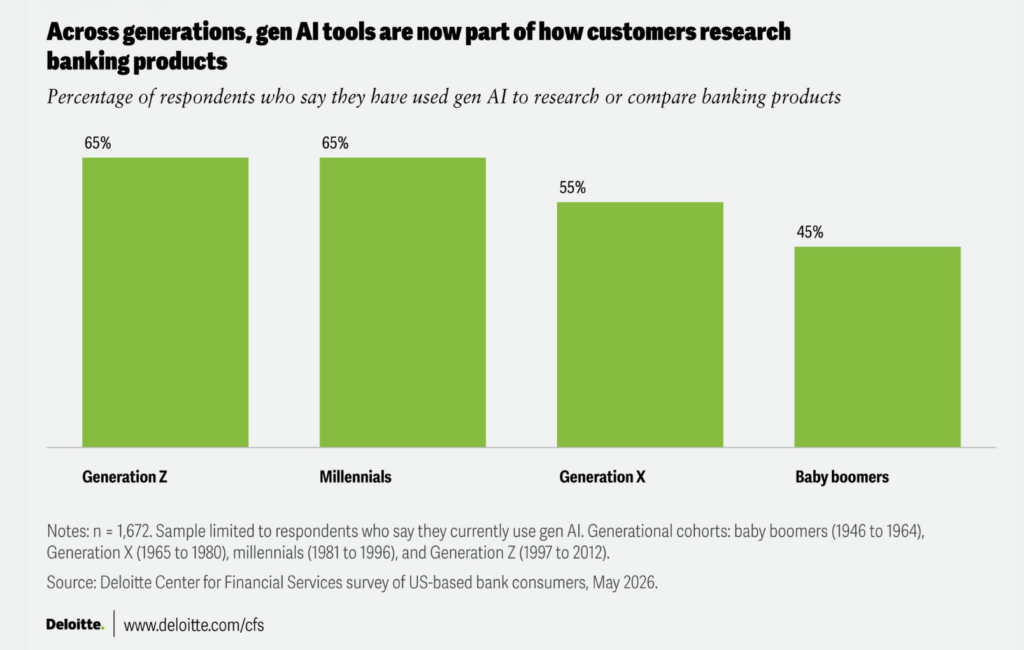
Among generative AI users surveyed, 65% of Gen Z respondents had used the technology to research banking products, compared with 45% of baby boomers. Trust showed a similar divide: 55% of millennials trusted generative AI recommendations, compared with 34% of boomers. Across the approximately 1,700 respondents who had used generative AI, 60% trusted its accuracy, versus 19% among nonusers.
Author

Get the latest insights about enterprise AI.
Subscribe to our newsletter. Thank you.




Be First to Comment