
TLDR
- FactSet centralized its AI efforts in a new AI Foundry.
- AI use has expanded from employee tools to client-facing agents.
- MCP lets AI agents tap FactSet’s data and established financial systems.
FactSet is reengineering how it builds and deploys AI, centralizing key technology teams in a new AI Foundry as the financial-data giant expands from deploying developer tools and encouraging employee productivity to building client-facing AI agents.
The company created the AI Foundry earlier this year after CEO Sanoke Viswanathan, who joined FactSet in September 2025, decided its AI work needed to be more centralized, according to Patrick Starling, senior vice president of AI product management at FactSet’s AI Foundry.
FactSet had already been using AI for a decade or more, particularly to automate the collection of financial data. But its AI development was spread across the company just as generative AI began advancing rapidly.
“We had a lot of people in a lot of places doing a little bit of AI,” Starling said in an interview with The AI Innovator. “We needed to centralize our core AI functions within FactSet.”
FactSet promoted CTO Kate Stepp to chief AI officer and brought AI leaders from product, engineering and strategy into the Foundry. The group is developing the company’s next-generation AI products, data strategy and agent platform, which other FactSet businesses can build on.
“Our goal is to set the foundation on which the rest of the FactSet organization will build and grow,” Starling said. “We are the ones launching our next-gen AI products, our AI data strategy, agent strategy and things of that nature.”
AI starts with the employees
FactSet began experimenting with generative AI internally early in the technology’s emergence, building its own governed chat platform to give employees access to large language models and avoid their use of public chatbots that might leak proprietary information.
The chat platform now gives employees access to multiple AI models that have passed FactSet’s internal governance process. FactSet runs the models through cloud providers including AWS, Microsoft Azure and Google Cloud and generally disables web access, giving the company more control over how corporate information is handled.
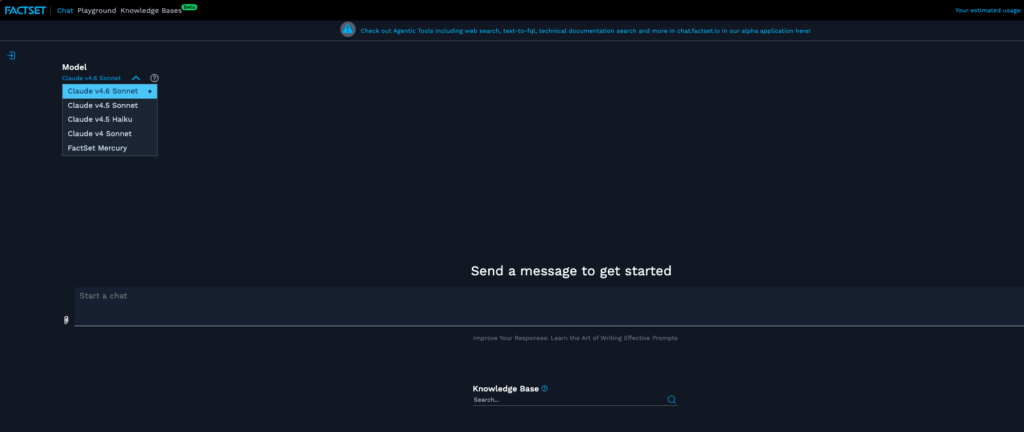
From there, FactSet expanded its use of AI into employee productivity, with software development becoming one of the biggest areas of adoption.
The company has about 3,000 engineers, and Starling said all have access to AI coding tools. FactSet also makes coding tools available to employees in areas such as product, marketing and sales, although budgets vary.
While the company initially used GitHub Copilot and Cursor, it was Anthropic’s Claude Code that “really took off for people, I think especially because it’s so usable by both technical and non-technical professionals,” he said.
To be sure, the company also imposes spending limits because rapidly expanding AI use can also create rapidly expanding token bills.
“For all the excitement that people have around the tools and this push on tokenmaxxing, we also realized that we need to be very deliberate in terms of our usage of everything. We can’t just have an unbounded financial liability around it,” Starling said.
As FactSet moves toward internal agents capable of taking actions rather than simply answering questions, Starling said the company is adding observability tools and tighter controls over what agents can access.
The company has also deployed targeted AI applications in customer success to help employees manage support cases and tickets.
From internal AI to financial workflows
FactSet has followed a parallel path with its customers.
Its first generation of client-facing generative AI included FactSet Mercury AI Chat, which is embedded in the FactSet workstation, along with AI capabilities incorporated into existing applications.
Starling described the strategy as “AI in context” – putting the technology inside workflows financial professionals already use rather than forcing them to move to a separate AI interface.
That approach is now expanding into agents.
In June, the company announced a partnership with Google Cloud to develop agentic solutions for finance. “They’ve got a really interesting stack and the fact that they own their lab while having the cloud and everything else sort of makes for a very interesting partnership with them,” Starling said.
FactSet sees an opportunity for AI to orchestrate established systems for portfolios, risk, performance and trading. Over the last decade, it has been investing in the portfolio lifecycle for asset managers, which starts from idea to trading a portfolio.
Asset managers “do want to bring AI to all of that. But each of those systems is in many ways its own system of record. It needs to be robust, production-ready, able to take on massive market days, high trading volumes, all those sorts of things,” he said.
With AI, asset managers can launch more funds and move into more geographies at a lower cost per unit. “That’s where tooling like we have around portfolios, around screening, around risk become fantastic things to be orchestrated by AI, which will give them that scale to be able to manage more AUM (assets under management) or more funds or more mandates but with a potentially lower growth rate on their employee headcount,” Starling said.
MCP connects the pieces
Model Context Protocol, or MCP, is becoming an important part of FactSet’s AI architecture.
FactSet was a partner in Anthropic’s July 2025 launch of Claude for Financial Services and later launched its own public MCP server. The protocol allows AI models and agents to connect to external data and software tools.
Starling said MCP is the next step in the company’s strategy of going to where customers are, having previously made its data available through APIs and cloud platforms. During the mobile revolution, FactSet launched a mobile app after people began transacting on smartphones.
Adapting to clients’ needs in the agentic era is no different. “For us, MCP in some ways is just the next iteration,” he said.
FactSet is rolling more data out through MCP while also using the same MCPs to build its own next-generation products. That allows clients to use FactSet data and tools through FactSet applications or external AI environments.
It also points to a division of labor in financial AI: increasingly powerful models provide reasoning and orchestration while specialized companies provide trusted data and deterministic systems underneath them.
Starling argues that better models will not eliminate the need for curated financial data by companies such as FactSet.
“In the past, we were distilling data for human consumption,” he said. “What we’re now doing is we’re taking that same data and making it easily available for agentic consumption, but the need for that quality distillation of data and normalization of data is even more important in this age of AI because it’s truly a garbage-in, garbage-out scenario.”
Financial information must still be normalized across accounting standards, reporting systems, industries and document types, he said. That becomes particularly important when agents are expected to use the information repeatedly and reliably.
“You can do really impressive stuff by pointing LLMs just at a ton of PDFs, but it’s not repeatable,” Starling said. “You can’t guarantee the quality. … That’s why I think financial data companies will continue to have a really key place in this future world. It’s just another new use for the data that we spent decades investing in the infrastructure to produce.”
Author

Get the latest insights about enterprise AI.
Subscribe to our newsletter. Thank you.